Showing posts with label meetings. Show all posts

Wednesday, May 4, 2016

How to Learn a Productivity System Part 3: Planning

“Soldiers, sailors, and airmen of the Allied Expeditionary Force! You are about to embark upon the greatest crusade toward which we have striven these many months. The eyes of the world are upon you.” - Dwight D. Eisenhower, supreme Allied Commander 

These were the words spoken before the D-Day invasions were executed.

In light of the immense planning that was required to pull off this amazing multi-nation, multi-front, humungous battle for freedom, another famous quote is also realized.
“Plans are worthless, but planning is everything” - Dwight D. Eisenhower.

D Day Invation

At home and at work I believe this quote about planning to be spot on.  It’s interesting to see how your brain works differently in a meeting or during an activity if you’ve done some planning versus when you wing it.


Consider Two Scenarios


Scenario #1: You receive an e-mail meeting invitation from a colleague titled, “Acme Contract” and the meeting is schedule for tomorrow. The body of the invitation says,”-Thanks.” You’re aware of the Acme Contract and you know you’ll be working on the Acme contract. If fact, you have some very specific feelings about the Acme Contract and how it will impact you and possibly others on your team.

You show up to the meeting and your colleague says, “We’ve got to update the contract and bid based on new input from my boss.  I’m showing the spreadsheet on the overhead. 

Let’s update the info to reduce the overall cost.”
Scenario #2: You receive an e-mail meeting invitation from a college titled, “Acme Contract Updates.”  The body of the e-mail says,

Goal: Review and Update Acme Contract Cost and Assumptions to Reduce Overall Cost.
Agenda: 
1. Review current contract and bid.
2. Re-assess assumptions
3. Update bid based on new assumptions
See attachment for current contract and bid assumptions.

You show up to the meeting and you know what the outcome is. Your brain has already been working subconsciously on new assumptions and ways to save costs. Your brain has a slight edge over Scenario #1.  

Ask yourself this question, “Assuming a 1 hour meeting, how much time is saved in Scenario #2 over Scenario #1?”

What do you think? 5, 10, 15, or 30 minutes?

If there are 3 people in the meeting you would minimally save 15 minutes total for your company and 5 for yourself.

If there are 5 people in the meeting and you save 30 minutes, you just saved 150 minutes for your company and 30 for yourself.  WOW. Do you think it’s realistic to save your company 2 1/2 hours of time?  

Surprisingly, I think you’ll find it’s very realistic and practical. If you do this, you’ll be a hero among your peers and in the eyes of your superiors because you’re creating more value in less time.

You might be saying, “Sounds pretty idealistic and like it will take a lot of work to create that goal and agenda.” 


A Mechanism to Train Yourself to Plan


1. Commit to never sending a meeting invite out unless you have at least one sentence in the body of the meeting notice, The GOAL: “Goal: ……”


It will take 1-5 minutes to write this single line but you will ALWAYS recoup that time by saving a minimum of 5 minutes in every meeting you host.

When you write the Goal statement in your e-mails it will force you to think just a little deeper. 


2.  Always include a concrete outcome in the goal statement.  


You would not use “Goal: Discuss developing a new app” as a goal statement. The word “Discuss” is not a concrete deliverable. The real PURPOSE of a meeting is not to discuss something. The PURPOSE of a meeting is to come to agreement and record decisions and action steps.  

A better goal, then, would be, “Goal: Create a Development Plan for the New App.” Now I have a pre-defined output for my meeting. At least for myself I know what I expect to get out of the meeting. At the end of the meeting I should have a draft plan to get from zero to new application.  

It works even better if you reiterate the goal at the start of the meeting so the brains of all the participants are tuned into the PURPOSE of the meeting. It’s like a magnet. The GOAL is one side of magnet and the people’s brains the other side of the magnet. Now the magnetic forces align.
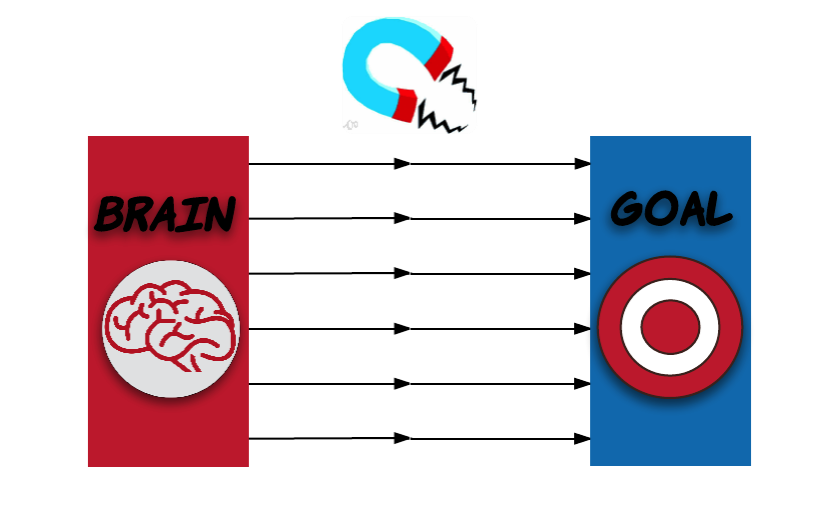
Magnetic Attraction

Often when I write the goal it requires me to dig deeper so I actually do some thinking and PLANNING. Within 1-5 minutes I clarify my intentions for myself and for others and my return on investment will be much greater than the time it took to do the hard work of thinking.

People don’t like wasting time in meetings, but when you put together a 5-minute meeting plan and you execute that plan and you get the necessary buy-in and collaboration with multiple people, you really create a win-win.

In fact, I consider holding and conducting meetings as a productivity enhancer because I can actually get a high level of collaboration and alignment from group sessions.  When you have strong and capable people working on complex projects, you might need more meetings to get alignment. But you don’t want meetings that result in throwing around random off-topic ideas or bringing up the baggage of how, “it didn’t work last time we tried this, so it’s doomed to fail this time."  

You need to get the creative energy FOCUSED on solution-oriented thinking. The GOAL will guide you to that end. Facilitation training can also be very useful. Read more about that skill in a full-scale facilitation process, “Change Your Meetings and Change Your Life with Meeting Facilitation (aka Meeting Magic).”

Please let me know the outcome of your experience using the “Goal:…” statement in your meetings.  

Wednesday, December 16, 2015

How to Find Great Ideas from a Massive Sea of Brainstorming Information

What if your team gives you way too many ideas to process when you ask them, "What needs improved"?

What do you do if  brainstorming results in a massive amount of information? How do you filter, focus and hone the important pieces?

You’ve just finished a meeting with your development team to discuss the next set of features for the upcoming release.  You’ve got a list of what seems like a hundred ideas. 

There is a massive list of unordered, yet very awesome ideas and you got those by BRAINSTORMING.  Now you need a fluid process to take that list of great ideas and make it something actionable.  


I introduced the Better Meeting Magic process in a previous article: Change Your Meetings and Change Your Life with Meeting Facilitation (aka Meeting Magic).

This article is a discussion of NARROWING.  NARROWING is the process that reduced a large set of data into a easily digestible chunks of information.  NARROWING is a natural part of all decision making. Whenever you talk to your friends or significant other about where you want to eat out, you begin a process that looks similar to the Agenda/Activity Cycle.  The group begins to throw out ideas, otherwise known as BRAINSTORMING:
  • “I feel like Mexican food” or 
  • “Italian sounds good to me” or 
  • “Chinese would really hit the spot” or
  • “I would really like some BBQ” 
Then someone might NARROW the choices by saying,
  • “I don’t like BBQ” or 
  • “Last time I ate Italian I got a really bad heart”.  

After that the group returns to BRAINSTORMING to further identify the possible restaurants
  • “How about Olive Garden?”
  • “What about Taco Bell?”
  • “Have you guys tried China Garden?”
  • “My favorite Mexican food place is Fajita Grande”
  • “What about that new high end restaurant  call Senior Primo’s?"
The group would then throw out Taco Bell … because they want to have a relaxed enjoyable dinner with a reasonable expectation of quality.  The group might also throw out Senior Primo’s because they are looking for a reasonable cost and casual dining.
NARROWING is done at this point at the point where you've prioritized the list and deduplicate the possibilities. The group has down selected to “Olive Garden”, “China Garden” and “Fajita Grande”.  Notice how a systematic process has been organically applied in this natural decision making cycle.  This is typical of the way we think and interact with each other. 
In the next article I’ll talk about the DECIDING step and how to apply some tips and tricks in that phase.
In a business setting or even at home, you might apply NARROWING to features for a product or vacation plans. In particular if you go to a destination like Disney World or a Resort where there are lots of things to do, you may need a decision process to help you decide which things are important enough to do or see.  On my recent family Thanksgiving trip to Colonial Williamsburg, I led my relatives through the entire Agenda/Activity Cycle a few times to consider the voluminous ideas and then reduce the list to a manageable size.  We had three days passes and the list of activities would easily fill 6 days so we had to prioritize. 

Here are some tips for NARROWING...

Tip #1: Duplicate Narrowing

If you recently finished BRAINSTORMING you are likely to have a large number of sticky notes or ideas. You will inevitably have many ideas that are either similar or identical.  When people start trying to prioritize the ideas, they will immediately want to find and group duplicates.

With sticky notes the simplest mechanism for de-duplication is to send the entire group of people to the wall or whiteboard and have them discuss and agree on how the items should be grouped. Have the participants physically arrange the sticky notes in groups.  Either overlap the sticky notes or move the sticky notes into clumps on the wall or whiteboard.

Tip #2: Timeline Narrowing

When it comes to a project timeline or feature timeline or anything time related, I like the timeline NARROWING.  Timeline NARROWING has the following rules:
  • The entire set of sticky notes must be arranged in a single line
  • There cannot be any overlapping sticky notes
  • There cannot be any wide spots in the sticky notes (two sticky notes above or below each other)
  • SINGLE ROW from start to finish
  • Entire group can work to move stickies forward and back in the timeline
  • Sometimes a large portion of the stickies must be moved left or right to accommodate for an insertions … no problem.
You might have noticed that I got a little redundant in writing this list. Most people do not like the single row rule. They say, “these things happen at the same time”.  While it’s true that things might happen at the same time, you must stick to the rules in order for our brain to do the hard work of prioritizing. Don’t make any exceptions no matter what someone says. Just say, “These are the rules to the exercise”.  Typically, people will find a few redundant things in the list and remove them as the timeline evolves.  NARROWING is all about prioritizing and eliminating, so have people do the hard work of thinking through the priorities and reflecting those priorities with the timeline of sticky notes.

Tip#3: Two Dimensional Narrowing

One of the most common two dimensional NARROWING activities EFFORT vs. IMPACT graph.  Using EFFORT on the vertical axis and IMPACT on the horizontal axis, create a graph on a wall or whiteboard. Then post your sticky notes into a two dimensional space with increasing EFFORT on vertical axis and increasing IMPACT on the horizontal axis.  Here’s how the exercise works.


  1. Have the group get into a single file line.
  2. First person in line can move a single sticky to a location he or she chooses.
  3. That person now goes to the end of the line.
  4. Or if the person does not want to reorder anything, then he or she can sit down.
  5. This exercise finishes when no one want to move anything.
  6. Repeat starting at #2.

  • Keep this exercise going faster by making it a no-talking exercise.
When you are finished you will have your list of items distributed in a two dimensional space where you can extract information on ‘LOW EFFORT/HIGH IMPACT”.  This provides a runway for your next task: DECIDING.

Thanks for reading.

Please try one of these strategies in your next BRAINSTORMING meeting and please leave a comment on how it went.  If you’ve done this before and have an observations, I’d love to hear about the result...write your experience in the comment section or send me an e-mail.

Read more at http://www.steveteske.com.


Wednesday, December 9, 2015

In a Meeting What is Best for Creative Problem Solving? Total Freedom or Well Defined Process?

Problem solving meetings should harness the energy and creativity of those who participate. 

Many people think that innovation and creativity are better expressed by allowing people to work without constraint or boundaries.  That works well in isolation, but if you want to harness the creativity of a group, you need a little structure.

For example, let's say on a Friday you task a brilliant person to come up with a great idea. He or she goes away for the weekend inspired and then come back on Monday with an outstanding solution.

Interestingly, this can be a double edged sword.  The solution can be suitable for a single solution or maybe even the enterprise, but it can also lack the necessary input to make it the best cross domain solution or perhaps be somewhat insufficient for a broader range of applications.  Other times, it can lack the buy-in from strategic stakeholders who might be behind it except for the fact that they didn’t get to walk through the process of understanding the trade-offs or “trade study” that went into the decision process. 

This is where a well structured Better Meeting Magic engagement can get you buy-in and collaboration and also bring the decision processes to closure relatively quickly.


In my previous article, “Change Your Meetings and Change Your Life,” I introduced Better Meeting Magic, a way to change the culture and productivity of a team, department, division or company that embodies the spirit of collaboration, inclusiveness and focus.


The box around “Agenda/Activity Cycle” reflects that this part of Better Meeting Magic is an iterative process that may be repeated many times during the course of a meeting. In some meetings, especially very long or multi-day meetings, you may have several decisions to make and you’ll need to run through the “Agenda/Activity Cycle” multiple times for each specific agenda item.  

BRAINSTORMING is the very heart of the “Agenda/Activity Cycle”.  Harnessing the flow of creative and collaborative thinking is the goal for the entire meeting, and BRAINSTORMING is the process of funneling the creativity into a specific thrust.  It’s super easy to be creative by yourself.  It’s also easy to be collaborative.  It’s harder to be collaborative and creative because people bring Bias into their decisions.  It’s extremely hard to be collaborative, creative, unbiased and deliver a good solution with time constraints.  The Better Meeting Magic “Agenda/Activity Cycle” can produced the desired result.


For any meeting where you need to get results quickly and come to a decision, you will need to formulate a game plan.  The game plan could be a simple 1 pass through the Agenda/Activity Cycle such as, “Brainstorm with sticky and select the top 3 ideas.”  Or the meeting could be a multi-day engagement where you have 10-20 iterations of the Agenda/Activity Cycle for multiple different topics. 

In either case, the facilitator of the meeting must plan in advance what activities that will be best suit for meeting goal.  In a recent meeting with a couple teams at my company we needed to re-work some of the network infrastructure.  Before the meeting I collected all the major network nodes and printed the names of each one on 8x10.  I brought the stack of printouts to the meeting and instructed to team to layout the network on the wall by taping each sheet of paper in the appropriate location using blue painters tape.  After they completed this initial activity, we began to restructure the network.

There are infinite ways to approach the brainstorming part of a meeting, and you can let your creative juices flow. But as the facilitator must come to the meeting with a plan for the activities.

Tip #1: Brainstorm with Sticky Notes


Using a physical piece of material (e.g. sticky note and fat markers) for capturing brainstorming is so powerful. 

• First there is the cognitive aspect of the writing things down.  
• Second there is the small amount of space that forces people to focus.
• Third there is the capability to easily move and categorize.

Tip #2: Always have people write down their own thoughts

In some meetings, there is a person at the whiteboard who is capturing thoughts.  I think there is value is this type of facilitation, but I do not recommend it for most BRAINSTORMING activities.

I recommend that the facilitator of the meeting plan enough time for people to write their own sticky notes and then personally walk up to the board or wall and post them.   This has a couple great effects:

  • The act of writing down your own thoughts gives ownership to the ideas and content.  If you summarize someone else’s thoughts in your own short hand, the words will likely be slightly off in meaning and tone.  That’s not always true, but it’s best to let the author of the idea carve their own art work.
  • The act of physically getting out of the chair is sometime uncomfortable for people. Maybe even awkward in some environments where sitting, staring at each and talking is the norm.  However, in meetings where people move around, there is much more energy and engagement. I usually insist that people get up and post their own notes keep the meeting lively. If you want people engaged, make them get their whole body in motion.


Tip #3: Create activities that engage both quiet and the talkative


It’s important that you engage both ends of quiet/loud spectrum in your meetings.  By default, meetings where people sit around and talk will be dominated by out spoken people.   Collaboration toward the best idea requires engaging all the stakeholders.  If a quiet stakeholder doesn’t speak out during the meeting, he or she may be holding the keys to a golden egg and never express the idea. Or he or she may be a position of having key knowledge and possibly power to veto the idea following the meeting.  Here is an examples of how to engage people on the loud and quiet spectrum.

‘At Least One Sticky’ Exercise


  • Instruct participants to write at least one sticky related to the current discussion
  • Instruct participants to walk up to the whiteboard or wall and post their idea
  • Either during the act of walking up or after everyone has posted, have each individual briefly describe their sticky 
Extracting at least one sticky forces engagement for everyone.  In my previous posts I talked about OPENING the meeting and having meeting rules.  I usually post the rules ‘Everyone Participates in Activities’.  In the event I have people who are resistant to be involved in activities, I re-iterate the rules from our opening.

When people talking through their sticky this enables the more verbal oriented people the capability to express themselves.  Since people want to both figurative and literally be heard, this part of the activity drives engagement.

Break out your sticky notes and create a super engaging meeting for your participants.

Go try this in your next meeting where you need to make a decision.  Please leave a comment on how it went…either good or bad or ugly.

If you like this content, please e-mail any friends and colleagues who would benefit.

Visit www.steveteske.com for more valuable meeting insights.

Wednesday, November 18, 2015

Improve Your Focus and Improve Your Teams Performance in Meetings


Today I almost went batty in a meeting.  It wasn’t just me, but one of my colleagues almost went batty as well.  Why? There was disconnect on the type of information that we needed to get from participants.  Other participants were wandering from topic to topic and could not constrain themselves to find the core purpose of the dialog. I looked at my colleague and I saw the strain on his face was barely contained (he was trying to maintain a professional posture).  The person currently talking had gone down a bunny trail of technical details that sounded more like a R2-D2 beeping and chirping to C3PO.  The purpose of the meeting was to inform the product owner how to make a decision about a couple different features in the upcoming release. The talker had completely lost touch with the goal of the meeting. I held my hands and requested a pause from the stream of consciousness monologue.  I reminded the team of the meeting purpose and we began anew with a better context and refreshed understanding of our GOAL.


In layman’s terms the bad behavior described above is called lack of meeting focus.  FOCUS is the root of productive personal and collaborative efforts at work and at home.  FOCUS enables people to reach a new state of productivity that some call FLOW.  FOCUS in meetings enables all participants to police themselves and police others so the meeting can make rocket propelled progress toward the GOAL.

The GOAL of a meeting is really the key aspect of meeting planning.  It’s the core of a productive person’s arsenal against distraction, negativity, bias, closed mindedness and unimportant topics.

In my previous article, “Change Your Meetings and Change Your Life,” I introduced Better Meeting Magic, a way to change the culture and productivity of a team, department, division or company that embodies the spirit of collaboration, inclusiveness and focus.

The diagram below repeats the Better Meeting Magic flow. This article describes the “Planning” component in depth. In fact, I've already introduced the most important aspect of planning: DEFINING the GOAL. 

The Goal

As mentioned above the biggest factor in making a meeting productive is defining the outcome of the meeting.  In Stephen Covey’s seminal work, 7 Habits of Highly Effective People, this is called “Habit 2 : Begin With the End In Mind.”  This powerful mechanism to challenges your brain to think about the outcome you would like.  Often a meeting is schedule because you know you need to talk about something that is blocking progress or causing friction or some collaborative decision needs to be made.  The meeting sponsor is often consumed with resolving the nagging issues, but sometimes neglects to define the core issue that must be decided before the meeting ends.

Tips for Setting a Goal: 

Tip #1: Make a goal for every meeting


When you create a meeting with your calendar application, stop before you send it and make sure the first line of the meeting description contains this line: “Goal: <fill in outcome here>”.
Force yourself to NEVER send another invite without a GOAL at the top of the calendar invite.

Tip #2: Keep your meeting goal concise


When you define the meeting Goal, make sure it has a measurable outcome.
You don’t need excess words in your life that don’t help you get to your destination.  You need explicit statements that guide the course of your meeting to a satisfying solution.

Tip #3: Make an artifact for every meeting


In the goal of your meeting, include the what artifact that you intend to create. You either want a “plan for marketing in a certain region" or a “vision statement for your department” or a “project plan with milestones for XYZ project”. 

Don’t sell yourself short and ask only for a “discussion”.  A discussion will always happen.  You want OUTCOMES.  ACTIONABLE steps.  Something that represents a DECISION or PLAN.   If you only have a discussion, you’ll have to meet again for a DECISION.  Don’t meet twice if you can meet just once.  In a later article, I’ll discuss other mechanisms to insure you manage your time and achieve your meeting goals.

Examples of good and bad meeting goals:

Good Goals:


“Goal: Discuss System Requirements for Project X and Create an Architecture Model.”

This is good because it has a specific outcome “Architectural Model.”  You might complete the meeting by finishing off a straw man architecture on a white board. Take a picture and e-mail the picture to everyone in the meeting.  GOAL ACHIEVED!

“Goal: Create an Actionable Marketing Plan for Product Y.”

This goal also has a specific outcome that you can measure, “Actionable Marketing Plan”.  You might end the meeting with a wall full of sticky notes that represent an ordered list of actions that the team will as execute.  You will take a picture of the wall, e-mail it to yourself.  Have your secretary transcribe it (or you can transcribe it) and send to everyone.  GOAL ACHIEVED!

Deficient Goal:

“Goal: Discuss the Needs of Customers in New York Region.”

While this may sound like a good goal, it does not end with an artifact.  In other words, what is the purpose of the discussion?  Do you want a sales plan?  Do you want to create a list of ideas? Do you want to create a demographic model? What is it that you want to ACHIEVE? A discussion can take place over lunch or over coffee or in the hall. You don’t want to waste time just discussing things, you really want to create something that can be instantly turned into a plan of action.

Let’s try again…

“Goal: Discuss the needs of Customers in New York Region and Create a List of the 10 Biggest Opportunities for 2016."

Now the discussion has a purpose.  It’s not a wandering meeting anymore.  The disciple of setting a GOAL is TOUGH.  This will challenge you to think a little deeper. You will spend a minute or two or three, but you will save many many minutes of people’s time and your own because you have a purpose in the discussion and everyone is now aware of that purpose.


If you know the end from the beginning, you’ll be a long way toward achieving your goals in a meeting.  It really only takes a couple moments to breath deep and put down your desired outcome.  Give this a try and see how it works to keep your meetings a little more FOCUSED.

When you think about creating a meeting, what things do you dread the most about conducting it?  Write me a comment and let me know.