Showing posts with label post-it notes. Show all posts

Wednesday, December 16, 2015

How to Find Great Ideas from a Massive Sea of Brainstorming Information

What if your team gives you way too many ideas to process when you ask them, "What needs improved"?

What do you do if  brainstorming results in a massive amount of information? How do you filter, focus and hone the important pieces?

You’ve just finished a meeting with your development team to discuss the next set of features for the upcoming release.  You’ve got a list of what seems like a hundred ideas. 

There is a massive list of unordered, yet very awesome ideas and you got those by BRAINSTORMING.  Now you need a fluid process to take that list of great ideas and make it something actionable.  


I introduced the Better Meeting Magic process in a previous article: Change Your Meetings and Change Your Life with Meeting Facilitation (aka Meeting Magic).

This article is a discussion of NARROWING.  NARROWING is the process that reduced a large set of data into a easily digestible chunks of information.  NARROWING is a natural part of all decision making. Whenever you talk to your friends or significant other about where you want to eat out, you begin a process that looks similar to the Agenda/Activity Cycle.  The group begins to throw out ideas, otherwise known as BRAINSTORMING:
  • “I feel like Mexican food” or 
  • “Italian sounds good to me” or 
  • “Chinese would really hit the spot” or
  • “I would really like some BBQ” 
Then someone might NARROW the choices by saying,
  • “I don’t like BBQ” or 
  • “Last time I ate Italian I got a really bad heart”.  

After that the group returns to BRAINSTORMING to further identify the possible restaurants
  • “How about Olive Garden?”
  • “What about Taco Bell?”
  • “Have you guys tried China Garden?”
  • “My favorite Mexican food place is Fajita Grande”
  • “What about that new high end restaurant  call Senior Primo’s?"
The group would then throw out Taco Bell … because they want to have a relaxed enjoyable dinner with a reasonable expectation of quality.  The group might also throw out Senior Primo’s because they are looking for a reasonable cost and casual dining.
NARROWING is done at this point at the point where you've prioritized the list and deduplicate the possibilities. The group has down selected to “Olive Garden”, “China Garden” and “Fajita Grande”.  Notice how a systematic process has been organically applied in this natural decision making cycle.  This is typical of the way we think and interact with each other. 
In the next article I’ll talk about the DECIDING step and how to apply some tips and tricks in that phase.
In a business setting or even at home, you might apply NARROWING to features for a product or vacation plans. In particular if you go to a destination like Disney World or a Resort where there are lots of things to do, you may need a decision process to help you decide which things are important enough to do or see.  On my recent family Thanksgiving trip to Colonial Williamsburg, I led my relatives through the entire Agenda/Activity Cycle a few times to consider the voluminous ideas and then reduce the list to a manageable size.  We had three days passes and the list of activities would easily fill 6 days so we had to prioritize. 

Here are some tips for NARROWING...

Tip #1: Duplicate Narrowing

If you recently finished BRAINSTORMING you are likely to have a large number of sticky notes or ideas. You will inevitably have many ideas that are either similar or identical.  When people start trying to prioritize the ideas, they will immediately want to find and group duplicates.

With sticky notes the simplest mechanism for de-duplication is to send the entire group of people to the wall or whiteboard and have them discuss and agree on how the items should be grouped. Have the participants physically arrange the sticky notes in groups.  Either overlap the sticky notes or move the sticky notes into clumps on the wall or whiteboard.

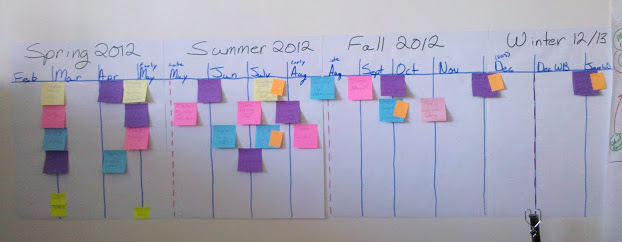
Tip #2: Timeline Narrowing

When it comes to a project timeline or feature timeline or anything time related, I like the timeline NARROWING.  Timeline NARROWING has the following rules:
  • The entire set of sticky notes must be arranged in a single line
  • There cannot be any overlapping sticky notes
  • There cannot be any wide spots in the sticky notes (two sticky notes above or below each other)
  • SINGLE ROW from start to finish
  • Entire group can work to move stickies forward and back in the timeline
  • Sometimes a large portion of the stickies must be moved left or right to accommodate for an insertions … no problem.
You might have noticed that I got a little redundant in writing this list. Most people do not like the single row rule. They say, “these things happen at the same time”.  While it’s true that things might happen at the same time, you must stick to the rules in order for our brain to do the hard work of prioritizing. Don’t make any exceptions no matter what someone says. Just say, “These are the rules to the exercise”.  Typically, people will find a few redundant things in the list and remove them as the timeline evolves.  NARROWING is all about prioritizing and eliminating, so have people do the hard work of thinking through the priorities and reflecting those priorities with the timeline of sticky notes.

Tip#3: Two Dimensional Narrowing

One of the most common two dimensional NARROWING activities EFFORT vs. IMPACT graph.  Using EFFORT on the vertical axis and IMPACT on the horizontal axis, create a graph on a wall or whiteboard. Then post your sticky notes into a two dimensional space with increasing EFFORT on vertical axis and increasing IMPACT on the horizontal axis.  Here’s how the exercise works.


  1. Have the group get into a single file line.
  2. First person in line can move a single sticky to a location he or she chooses.
  3. That person now goes to the end of the line.
  4. Or if the person does not want to reorder anything, then he or she can sit down.
  5. This exercise finishes when no one want to move anything.
  6. Repeat starting at #2.

  • Keep this exercise going faster by making it a no-talking exercise.
When you are finished you will have your list of items distributed in a two dimensional space where you can extract information on ‘LOW EFFORT/HIGH IMPACT”.  This provides a runway for your next task: DECIDING.

Thanks for reading.

Please try one of these strategies in your next BRAINSTORMING meeting and please leave a comment on how it went.  If you’ve done this before and have an observations, I’d love to hear about the result...write your experience in the comment section or send me an e-mail.

Read more at http://www.steveteske.com.



Monday, November 9, 2015

Change Your Meetings and Change Your Life with Meeting Facilitation (aka Meeting Magic)


This article talks about tools to improve productivity every day at your job.  How do I know it works? I've seen change for the better in relationships and in the output of my teams and colleagues.

In 1994 I graduated with a computer science degree and started working at a large telecom company which specialized in wireless telephone networks. From day one I learned that knowledge is power and expressing your well-informed opinions loudly and with passion can move you up the power curve in an organization.


As I navigated my way from “Member of Scientific Staff” (that was my title, no kidding) to “Senior Member of Scientific Staff” then “Individual Contributor/Architecture” and finally to “Software Development Manager” I found that my voice was heard more often if I used it loudly and forcefully.  The downside of an outgoing and dominant personality is that you get your way often, but you don’t always get the best from other people and you create friction along the way.


In 2005 I took a role at another company as a “Team Lead/Scrum Master” and used the same skills that I’d learned in the first decade of my career.  I noticed that other individuals also used the be-loud-and-dominate technique.  Now, when there were two leaders saying different things in the organization, two parties would form and the differing opinions would create a small turf war.


In 2008, after participating for 14 years in the party system of technical decision making, I took the role of department manager and I WAS SCARED SPITLESS because I was taking over leadership of an organization where I had participated in a system that rewarded loud and overbearing people; some of which I had offended by using my techniques of domination instead of collaboration.


WAKE UP CALL.


Faced with a department divided against itself, I realized I needed to drastically alter course.  So I studied hard to change my mindset and my behaviors. I read book after book and listened to people in the organization that showed management skills coincident with what I was learning in books.  


What I learned in these books and in my interactions with leaders in the organization is, I really need to behave with humility and try to draw out other people’s knowledge and skills.  And at the same time firmly demand discipline from myself and others to focus on solving problems and never drag the rhetoric of workplace or personal history into a arena where creativity and action are needed.


In 2011 I took a course called Agile Team Facilitation as part of my career development and also an Agile development initiative at my workplace. Read more about how a got involved in that course here. The material in the course not only reinforced all the learning in my post WAKE-UP CALL years, but also provided specific skills for applying collaboration and action into every interaction with teams of any size.  Instead of Facilitation, I call it Better Meeting Magic. Better Meeting Magic embodies the spirit of collaboration, inclusiveness and focus that can and will change the culture and productivity of a team, department, division or company. The results that I’ve seen in my current company reiterate the bold statement of change offered in this article.


Better Meeting Magic is pretty simple and includes the following meeting flow:


The description of the individual activities in Better Meeting Magic are as follows:


Planning
Know what you want out of a meeting before you go into a meeting
Opening
Introduce the overall meeting goals and agenda
Bias Check (optional)
Allow people to express themselves with specific activities to safely capture bias
Brainstorming
Collaborate and generate ideas
Narrowing
Remove duplicate thoughts, reduced decision set to a manageable number
Deciding
Decide what action(s) to take
Retrospective (optional)
Get feedback on how the meeting went or how comfortable people are with the outcome.
Closing
Summarize the meeting results and capture follow-up activities
Follow-up
Make sure minutes and actions captured during the meeting are addressed


You and your teams spend a lot of time in meetings. You need relief from unfocused discussion. You need a better way to increase output from your meetings by 2 to 4 times.  Better Meeting Magic can deliver all those things.


I will be posting a number of follow-ups to cover each specific activity.  Please stay tuned as I talk in depth about each component of Better Meeting Magic.


Please leave comments and tell me about the most frequently propagated meeting sin in your company.

Also, please signup to receive the free Productivity Guide and also subscribe to Productivity in a Mobile World blog.

Wednesday, November 4, 2015

How to Plan Your Family Vacation Using Post-It Notes (aka Sticky Notes)


"Doctor Sticky Note". That’s what my family calls me.  Strange name for a software project manager, but perhaps it’s accurate given how I do my job.
In a previous post I talked about how to have awesome meetings using meeting facilitation. And in this post I want to tell you a little bit about how that same type of activity works wonders with your family and with other groups of people when there are decision to be made and lots of opinions from lots people.
Thanksgiving 2011 was gearing up to be great time with family and friends all around.  We decided to have Thanksgiving at my house and invite all the aunts, uncles and cousins to come to the mid-Atlantic for our traditional family get together.  Normally we all met in the mountains of Tennessee, but this year my family needed to stay at home so everyone came to us. It was going to be a pretty large gather and so needing extra space, I borrowed a nice sized camping trailer from a friend to accommodate an extra 5 people beyond what my house might hold.  I think we had a total of 14 people that year with a wide mix of ages.
In order to figure out what we would I conducted the first ever facilitated large scale family Thanksgiving planning activity with sticky notes and a white board. This was the first activity we did after everyone arrived and got settled. The meeting was intentionally planned to be brief so that we didn’t take away from the many activities that people wanted to do.  In the end, we accommodated the shoppers, the athletes, the museum goers and the eaters.   Since I live near Washington, DC, there is a lot to see and do and most people want to take an adventure down town.
The sticky note exercise was conducted in order to provide each family member from the youngest to oldest the opportunity to give input to the schedule.  The youngest was 7 and the oldest was approaching 70.
Since this was a family oriented holiday and because we like each other it was important that we did most everything together. I suppose not all families want so much together time, but we made it a rule in our planning to have lots of "togetherness." Considering the diversity of the group, I used a sticky note brainstorming technique to elicit all the activities that everyone wanted to accomplish during Thanksgiving. We had “Shopping”, “Museum”, “Bake Pies”, “Make Thanksgiving Dinner”, “Eat Turkey”, “Run Turkey Trot”, “Go Hiking”, “Church”, “Sleep”, “Play Games” and a few more.  If you calculate the time from Wednesday to Saturday it was a lot to accomplish in a just four days.
The second step in our meeting was to rank all the activities and reduce any duplicate items so we could focus on the individual things that seemed to stand out as unique activities that required a block of time. Ranking was done using "dot-voting." This technique is used to pick the top items from a list. If you want the top 3 things, you give each person 3 dots. Each person can distribute dots however they see fit. One person might really want to run the Turkey Trot, so he might put all 3 dots on that sticky. Other people might evenly distribute their dots across different activities. In the end everyone can see the priorities of the majority. For families this type of decision process (i.e. voting) might leave someone feeling left out. You attempt to introduce the voting concept and how the process works so people can understand and warm up to the idea of going with the flow of the majority. In some cases the majority rule doesn't work, so you can enable everyone to pick a "must have" activity and it will happen even if an activity has only one individual who wants to do it. If you use the "must have" decision tool, it's almost always the case that many "must have" activities are shared by many of the individuals and only a small fraction of activities are only selected by a single person. As for the mechanics of "dot voting", If you don't have sticky dots, simply use a marker for each person and have them make ink dots or put their initials on the sticky not they want to vote for.
The third step was creation of calendar on a whiteboard where we divided up the days into 4 parts.  Early morning, mid-day, afternoon and evening.   We labelled each column with a day of the week starting from Wednesday and progressing through Saturday.  We created rows for each of the time slots so we ended up with a matrix that would be populated by activities.
The fourth step was a fun exercise where we took turns to either put one sticky on a certain time slot or move an event to a different timeslot. One at a time family members would come up to the board and place an event or move an event.  This continued until everyone was happy with the schedule.
Every year since this event (including this year 2015), my family members remind me of how much fun they had creating an active, fun filled Thanksgiving celebration in which everyone helped create a plan and all family members had a voice.
The plan we created together turned out to be pretty practical.  If I recall, we actually did everything on the list. In very few cases a family member or two would say, I’m skipping this. But that was very rare and the family was aware of the importance of some events vs. others because of the discussion during the planning.
The moral of this story is that “The Family that stickies together sticks together”. 

This is a powerful example of applied facilitation techniques.  Several of my family member encouraged me to broadcast these techniques because they found the results amazing and the concept of facilitation to be extraordinarily valuable.
My Uncle owns a successful food distribution business and is considering using these techniques for his annual employee meeting.
My Cousin is evaluating these techniques for use in his medical field.
Personally, I use these techniques every day in my software project management role because I find the increase in meeting productivity to be in the neighborhood of 2 for 4 times.  In other words, you could reduce a sequence of meetings from 4 meetings to 1 meeting.  Or you could shrink a 2 hour meeting to 1 hour.  Or you could get twice as much done in a 1 hour meeting.  Facilitation in meetings and group settings is revolutionary.
Do you find your family stretched to the limit with activities?
Please send me your toughest family planning issues via e-mail. Let’s talk about how to solve it.
-Steve.

Monday, October 19, 2015

How to Create an Awesome Meeting that is Massively Productive and Laser Focused

In 2012 I had the great fortune of meeting someone I will call one of my best Agile mentors, Ahmed Sidky. Learn more about Ahmed at dragile.com. Ahmed doesn’t really know me that well, but I have pretty much done everything he told me because I saw that he really understands how to get things done in a business environment.  And by that I mean he knows how to take an organization from performance level 1 and move them through a series of steps until they are performing at level 5 (on a scale of 1-5, where 5 is awsome).


During late 2011 and early 2012 my former employer was on a quest to get better at Agile Software Development. While pursuing a better agile process, I gained some revolutionary insights from Ahmed that sent me down a path of learning and experimenting and productivity that has forever change how I work and interact at home.


The killer app for meeting productivity is facilitation.  And I’m not talking about ordinary meeting facilitation, I’m talking meeting facilitation on steroids.  Don’t quit reading because I used a boring word like "facilitation", this well-practiced art will change your productivity level across the board.  I’m now a ICAgile Certified Agile Team Facilitator and that training is golden.


By the time you finish reading this article, you should be equipped to start a change in your behavior at home and at work that will bring you better success in getting things done during meetings or gatherings and make you renowned in your workplace and with your relatives.  Getting to “black belt” facilitation might take a while, but you will see an impact very quickly.


Do the following things in your meetings at work and you will take down mountain-sized problems as easily as Spiderman swings on his web.


1.  Create a plan in advance

Create a plan in advance that will utilize well-defined exercises that fit into time boxes. If you really want to be productive and take on the hardest problems, you will have to prepare in advance. In my workplace, I usually conduct at least 1 or 2 facilitated meetings a week and about every six months I have a 1 or 2 day facilitated meeting for an architecture summit or new project kick-off. For each of these meetings I prepare a plan that includes desired outcomes and activities to support each outcome.  I would typically have a minimum of 3 activities for a 1 hour meeting and probably around 5-8 activities for a 1 day meeting.  An activity is simply a means to capture information from the participants.  It could be a simple as this Hopes & Fears activity: “Please put one post-it-note under the ‘Hopes’ label on the whiteboard (or wall) and put one post-it note under ‘Fears’ label on the whiteboard (or wall). Only put one thought on your post-it notes”.   
This exercise is fantastic to kick off a meeting because you usually get people to admit they think something is dumb or broken about this meeting or the topic and you get people broadcasting their desires about the outcome of the meeting.  Brilliant … you’ve got super insight into the participants minds.  And they are energetically involved in the meeting.

2. Write down the meeting Goal

Always write a Goal in your meeting announcements (Outlook or whatever). Why does this work so well?  Writing a goal is  a focus technique that puts a meeting on rails.  First the creator of the meeting must actually think deeply (even if the depth is only 30 seconds of thinking) about the outcome of the meeting.  This is critical because everything hinges around a clearly stated goal.  A poorly stated goal like, “Discuss the XYZ Widget”, will not likely produced a good result.  Powerfully stated goals like, “Create Milestones for developing and deploying PDQ Web Application.”, will give the meeting focus and a desired outcome. Moreover, you can know that you will have a successful meeting if you get an artifact. Yes, if you get an artifact out of your meeting then you’ve actually succeeded at have a mildly productive meeting. An artifact could be, “Milestones”, “Project Plan”, “Actions” or an “Architecture”.  Make sure your goal somehow alludes to the creation of artifacts.

3. Put away computers and use whiteboards and post-it notes

Use white boards, flip-charts and sticky notes instead of letting people sitting around a table.
Sitting around a table is the standard methodology for conducting a meeting, but it does not expedite decision making nor does it encourage full participation from all the attendees.  Sitting around will actually exclude quieter people and allow unrestrained talkers to carry the meeting down rabbit holes and snake pits.  I already mentioned how planned activities are necessary before a meeting, and they add a second benefit of creating a level playing field for the quiet and the loud.  Leveling the input is critical for brainstorming because the flow of good ideas is actually proportional to the number of smart people contributing.  And not all smart people talk a lot. I usually tell people when I start a facilitated meeting that they can expect the unexpected and that they need to agree to participate in some strange activities.  No one has ever rebuffed my request for participation, even the C-levels.


Go forth, make a plan, make a goal and make people stand up, walk around a talk to each other with a focal point of a drawing on a whiteboard or patch of post-it-notes on the wall.  People are very visual and without good visual aids, humans use hordes of words to describe complex things.  Give people the gift of using a picture on board or collection of words on a wall to help them clarify their ideas and cease the deluge of possibly confusing words.


I’d love to hear from you about your experience in meetings?  Do you have some tried and true techniques that really help you get productive in highly creative meetings?


Please write me an e-mail and tell me about the biggest challenge you face when conducting a meeting?