Showing posts with label goals. Show all posts

Wednesday, June 1, 2016

Improve Agile Meeting Productivity 2x-5x

Let’s say your personal productivity is awesome. Perhaps it’s not perfect, but it’s pretty good. You have habits that are working well. Perhaps you’re waking up, getting some exercise, reading, and working on your big goals.  At work you may even have your e-mail inbox under control.

But your work environment is chaotic and your meetings are wasteful. See if you find anything familiar in this typical scenario.


Example of a Wasteful Meeting


Meeting Idea


Your boss says, “Let’s decide how to create an architecture for the next generation of our software product. I’ll schedule a meeting to discuss the architecture.”

Don’t get alarmed yet, but NEVER have a meeting to DISCUSS something. Only have meetings to DECIDE something.


Meeting Invite


The meeting announcement goes out saying, “Future Architecture Discussion.”

The body of the meeting says, “Let discuss the future architecture of our application that will support the upcoming requirements.”

Now you should be a little alarmed. This meeting is not looking like a good use of your time because there’s no definitive deliverable. 

Meeting Time


The meeting time arrives and all the very opinionated, smart, capable, driven, and highly effective people arrive in the room and take seats around the table. For the purposes of this (nearly historically accurate) example, let’s assume there are 6 people attending the meeting.

If everyone arrives roughly on-time, you have already saved many minutes of the start-stop-restart cycle.

When the meeting host settles down in his or her chair WITHOUT a note pad and only a cup of coffee in hand, you should begin to raise the alert level to DEFCON-3.

This style of meeting will result in NO MINUTES and possibly NO DECISIONS. 


Meeting Flow


During the meeting there is a flurry of different topics that come up.  The meeting starts with architecture, but shifts subtly to some interesting topics:
  • What if the marketing guys have got it all wrong?
  • What if the CEO won’t fund the architecture?
  • What if the current application technical issues cause the team to spend 50% of their effort fixing bugs instead of creating the new architecture?
  • Etc.
These are interesting but they’re enticing, emotional, and USELESS in regards to the architecture discussion. 

Alert raised to DEFCON-2.


Meeting End


Near the end of the meeting, people begin to look at their watches saying they are have another meeting to attend. Nothing has been written down.

Like nuclear war, once the missiles are launched it’s too late to rescue this meeting. Raise the alert status to DEFCON-1 - Maximum alert.


Is There Another Way?


The example above is likely to resemble some of the meeting norms where you work. Inefficient and ineffective meetings might be a cultural norm, but it’s not the way it has to be. 

With a little attention at each step in the meeting process you can improve the effectiveness and increase the collaboration in your daily meetings.

Meeting and cultural norms

Example of a Productive Meeting

Meeting Idea with a Deliverable


The boss suggests that you gather the technical leaders and determine the next steps in the architecture evolution. She says, “Can you get with the team and develop a roadmap for the architecture?”

You’re empowered to create a ROADMAP. This is the deliverable from the meeting.


Meeting Invite With a Purpose


You think for a few minutes and decide on the goal for the meeting. “Create and record a roadmap for application architecture with a 5-year horizon.” 
In addition, you come up with a rough agenda.
Agenda:
1. Review the marketing requirements
2. Record highest risk items
3. Create a list of architecture changes necessary to meet the business goals.
A meeting invite with a purpose can result in 2x improvement because it primes the brains of all the participants to think about the problem ahead of time.
With a goal, you can take your 2x productivity to the bank by shrinking your meeting length by half.  

With a goal and agenda, you could find a 3x impact.  A meeting that normally takes an hour could take 20 minutes.  The meeting ends when you’ve reached your defined goal and know how to get to the goal with a written plan.


Meeting Time With a Prompt Start


Depending on the business norms in your company you’ll experience very different meeting norms: for example, habitual tardiness to meetings. One way to shift business norms is to start on time.

In one meeting I hosted the attendees arrived on time, but were quite talkative about numerous subjects. In order to move the meeting forward, I said, “I can make your Friday shorter if we start on the review right now.” And then we got down to business.


Meeting Flow With a Plan


When it comes to meetings, there’s nothing like a good plan. A colleague  quoted once, “Never attend a meeting that you don’t control.” Perhaps that’s a little extreme, but I would say you should always have a plan for the meetings you host, including slides and/or a facilitation plan.

At the minimum I create Powerpoint slides to keep the meeting focused on a specific outcome. When you have a representation of the goals, people have a much easier time keeping their focus. 


Meeting Flow With a Turbo Charged Plan


Since people are very visual and actually engage with more energy when standing, consider using sticky notes or a whiteboard. Sticky notes are especially effective because they can be moved and re-arranged easily during a discussion.

Copy paper and blue masking tape are also very useful if you have information prepared before hand.  

To increase the effectiveness of sprint grooming or planning meetings I often print out sprint backlog titles to tape to wall. Then I have the team create a task breakdown using sticky notes that are placed in order under the backlog item. I use the Post-It Plus application to take a picture of the the wall.  The application recognizes eat individual sticky and exports the sticky notes in several formats. Excel is useful when I have a large quantity of notes. I then get the notes transcribed.


Meeting End With Closed Loops


At the end of the meeting you should have the following.

1. Actions recorded
2. Decisions recorded.

No matter what kind of meeting you’re holding, the end game must conclude with decisions and actions recorded.


When You Need a 5x Strategy


Under normal meeting circumstances a goal and agenda are sufficient to succeed. But sometimes a meeting deals with highly emotional or widely debated topics that need a 5x strategy. Without a 5x strategy, you’ll lose hours of time and potentially create even more tension.

Productivity of 5x is possible and realistic when you come prepared with a detailed facilitation plan that includes well planned activities. The plan should include strategies and activities for:
  • dealing with peoples biases (mental or emotional baggage) 
  • effective brainstorming
  • taking large quantities of creative input and move it towards a decision
  • keeping the level of engagement high so that the participants keep their energy and intellect focused on the topic
  • engagement during the meeting with boundaries
  • any needed follow-up
The article “You Can Have Better Agile Meetings” provides a overview facilitation flow. 
If collaboration attempts fail and the emotions or topics remain unresolved, the most common alternative is to call in the higher authority to resolve the issue.  

This is a weaker approach that could result in temporary solution, but with a high probability that the parties will find “insurmountable issues" with the top down decisions as soon as the slightest obstacle is encountered.

Conversely, the gains from a 5x strategy can achieve a lasting consensus and full buy-in from your team members.

Please leave a comment about the most debated topic that needs to be solved in your work place? 

Thursday, May 26, 2016

How to Learn a Productivity System Part 6: Making it Work

Is your work enjoyable?


If it is, then you might be more amenable to call everything you do at home and at the office work.  If not, let’s reframe for a second.


Work = Effort toward a Goal


If the equation holds true, then what you do at home (home maintenance, vacations, personal finance, raising kids, plans of the future, health fitness and hobbies) is also WORK.

What’s interesting about calling all of our life activity ‘work’ is the sense that work is something that you do with purpose.  You want a result for your effort.

The business mind is focused on achieving the business goals, the revenue, the growth, and the sustainability of business.  

The personal mind is focused on seeing how to prepare kids for life in the future, enjoying a vacation, re-training for another career, reducing the stress in life, spending more time with your spouse, changing ingrained habits or starting on a bucket list item.

The business mind has a natural craving to design and execute goals. The rewards are very tactile.  When you do a good job for a customer you might get a thank you, and of course you get paid.  

For salaried folks, you might not see the transaction so vividly, but we want to get the project or tasks done and often we are measured during the year for achieving specific goals.  Achieving goals results in a better review and potential earnings growth, maybe a promotion with more scope.

The personal mind requires a lot more proactive behavior to create the goal.  Personal goals are not laid out by the leadership of the business, they are created through personal leadership.

Personal Leadership

For specific steps on how to employ personal leadership see the prior articles on “How to Learn a Productivity System.”  Part 3, 4, and 5 are focused almost completely on personal leadership.  Parts 1 and 2 are focused on tactical ways that you can create time in your day so you can spend more hours doing the strategic tasks needed to increase your personal leadership.

How to Learn a Productivity System Part 1: Capture

How to Learn a Productivity System Part 2: Actions

How to Learn a Productivity System Part 3: Planning

How to Learn a Productivity System Part 4: Goals

How to Learn a Productivity System Part 5: Evaluate Life Dreams

Which is more important, business mind or personal mind?


That is a tough question.

The business mind provides the How-the monetary sustenance.  

The personal mind provides the Why-the Character and the Motivations.

The answer: They are both important.  They both impact each other.  


A personal example of interleaving the personal and business mind


In 2005 I took a role as a “Team Lead/Scrum Master.My leadership style was centered around high volume and persuasive intimidation.

In 2008, I was promoted to department manager and I WAS SCARED SPIT-LESS. I had engaged in numerous technical and political battles with my peers over the years, and now I was taking over leadership of a team that knew my reputation as loud, overbearing, manipulative person. I had created animosity with a couple of the most senior and respected individuals by forceful getting my way using pushy tactics.

Answering the wakeup call


Faced with managing a team that saw me as an antagonist rather than a helpful resource, I realized I needed to drastically alter course.

In the months and years that followed my promotion, I studied hard to change my mindset and my behaviors (and I still study hard to this day). I read book after book and listened to people in the organization that showed management skills coincident with what I was learning about effective personal and public leadership. I moved my personal style from directive-authoritative to servant-leader.
This personal study to improve character created a deep well of good behaviors and resulted in better quality of life in both my personal sphere and in the business arena.
People in my organizations gave me feedback that they had grown to respect me over time as I demonstrated consistent other-centered leadership.

Personal leadership has a broad impact


Isn’t it interesting that the personal mind has such a great impact everywhere?  It might be the more important mind after all.

The moral of the story is this: No matter if it’s personal or business it’s WORK.  And if it’s work, it needs a system to move toward the goal. 

One of my favorite authors, David Allen, has a great book on this very topic called, Making it All Work.  He provides an entire book dedicated to creating a unified productivity mindset around personal and business goals. David Allen’s previous book, Getting Things Done describes a comprehensive productivity system which is now known globally as GTD.

What is not working in your personal or business system?  Write a comment or send me an e-mail and let me know? 

Wednesday, May 11, 2016

How to Learn a Productivity System Part 4: Goals

My kids have awesome dreams for the future. 

One of my kids wants to be a movie producer. One wants to be a famous actor. One wants to travel the world.

For myself, I still dream of being a race car drive (Yes, it’s true I still this dream even as a middle age person). 
These are examples of dreams and dreams can come true.  However, inorder to make a dream a reality, it must be decomposed into a goal.

Dreams cost you very little energy and time.  You can spend 5 minutes envisioning yourself crossing the finish line of a marathon or making decisions as the head of your own company or seeing yourself on the beach with your family in Hawaii or leading a large community of people to serve others or heading up significant a social change in your country or seeing your children live with integrity and principles.


And now the hard parts begins.  

Goals on the other hand, require much more than 5 minutes to write down.  And then they require much more energy and time to achieve once you’ve really put them down on paper and committed yourself to achieve the goal.
Some people have the capacity to keep all their most important dreams and goals totally encapsulated in their heads and then connect those to action. Those people are very rare. 

Most people need to take deliberate action to translate dreams into well written goals and then decompose goals into specific action steps.


Simple Dreams and Goals


Dream: “I want to have more energy and less stress.”


This is a great ambition.

What gives a person more energy?

Studies show energy is rooted in good habits around sleeping, eating, drinking water, exercise and good mental health.

In fact, there is a study showing that active people have about 20% more energy. If that is true, then we can decompose a dream of having more energy into a goal about being active.


Goal (Weak): “I want to exercise so I can have more energy.”


The weak goal above has a couple elements to help a person move toward more energy, but it lacks some critical elements.  The strong goal below includes the extra elements that remove the ambiguity about the frequency of exercise and the duration of exercise which are required ingredients to improve your chances for success.


Goal (Strong): “I want to exercise for 20 minutes, at least 3 times per week and do that consistently throughout 2016.”


This is much better and and more potent goal that has the potential to start a good habit.

Breaking that down further results in a plan of action which I talk about in the article, “How to Learn a Productivity System Part 3: Plan

We’ll create a specific plan for this goal of exercising which should put us on the road to 
achieving the dream of “having more energy.”


The Plan:  “I will do (yoga, a walk, a run) for 20 minutes on Monday, Wednesday, Friday right after I get up at 6:00 am.”


More Complicated Dreams and Goals


Dream: “I want to be a CEO of my own company”


Interestingly, I’ve had this dream myself for many years. And as I looked around at the big company I was working for, I was overwhelmed with immense obstacles that seemed to bar the way:  I don’t have an MBA. I didn’t attend Harvard, Yale, or Stanford. I’ve never started my own company before.  

WAIT a minute.  “I’ve never started my own company before.”  What am I thinking?  Starting my own company for the first time automatically makes me a CEO. Right?

After some contemplation I became aware that I didn’t really know what my company would do or what it would sell or what type of service it would provide.
So that dream was a little narcissistic in that I didn’t really have any purpose or obvious value to offer. It was more a ‘dream’ fueled by the desire for prestige.

To build a sustainable dream, you must insist on offering value.  And you might argue that I’m wandering into the gray area of the philosophy of what makes a good dream vs. a bad dream. And you would be right. I think there are principles which should be followed when deciding about which dreams to chase vs. curtain.

Here a restatement of the original dream, but this rendition has a value statement.


Dream: “I want to lead a company which helps individuals and business maximize their productivity.” 


This dream has more tangle value statement and can more easily be generate goals and plans.


Goal (Weak): “Create a business to help people be more productivity”


This goal makes sense in that it provides a more focused idea (creating a business), but the weak goal lacks a time frame in which to execute the business activity, which will enable procrastination rather than accountability.


Goal (Strong): “Have a profitable business that serves productivity minded individuals by 31 Dec 2016.”


The strong goal will provide the qualifiers and deadline that make a idea into a GOAL.The Strong version also provides the necessary ingredients that make up a ’SMART’ goal: Specific, Measurable, Attainable, Relevant and Timely.  

Let’s examine whether or not this goals passes the SMART test:

Specific - There appears to be pretty specific outcome to this goal which is a ‘profitable business’ that serves a ‘productivity minded’ market group.  The term ‘Specific’ is probably one of the gray areas to the ‘SMART’ goal definitions because the definition of ‘Specific’ can be broadly interrupted. However, the strong goal appears to meet this criteria.

Measurable - The word ‘profitable’ is a little loose with respect to measurement.  Does this mean profitable over the whole year or profitable for one month or profitable since the dawn on time. This actually needs work. Let’s propose that this be modified to say, ’…profitable for 1 month in 2016’.

Attainable - Depending on the expenses to run the business and the time allocated to running the business, this could be very attainable or it could be unachievable.  For the context of this goal, let’s assume the expenses are very low and the time commitment for the business is roughly 10 hours per week.  That sounds attainable.

Relevant - I think this hits a home run for relevant category because it flows directly from the Dream.

Timely - There is a deadline on the goal, so this is also spot on.


Takeaway for Dreams and Goals


When it comes to creating goals and plans, there is a cost equations.  
Dream-to-Plan Time = Size of Dream * Goals Creation Time * Plan Creation Time

Notice this is what we call an exponential equation.  That means if you have a big dream, you’ll need to put in big time.  Maybe not all at once, but definitely over the life of your dream.

Let’s consider another complex dream to illustrate the cost principle.


Dream: “I want to have children who live with integrity and principles.”   


You will probably need to spend time working on that dream every week. If you are a parent, you are probably already investing time in this area through many different activities and interaction with your kids. 

Below is one example goal that is decomposed from the dream.


Goal: “Provide daily personal input into children’s lives regarding life principles.”


Let’s break this down and see if it complies with the SMART goal format.

Specific
- Very specific


Measurable - The measurement is to do this everyday. 

Attainable - Seems reasonable

Relevant - Very relevant toward the dream

Timely - This is a bit redundant with measurement in this case.  It’s a daily thing.

And then there is a plan that comes out of this.


Plan: “Read a quote or article or affirmation at breakfast that captures a life principles and briefly discuss.”

As a parent, you might say, “I do this as a course of everyday living.  I teach by example. I teach at every opportunity.”  And I think you are correct.  Keep up the good work. 

Sometimes it gives you a boost if you can do something very intentionally rather than in a reactionary situation.  Intentional situations are usually more relaxed and the child’s brain is ready to receive input.  In reactionary situations, such as teaching in the heat of the moment or when something went wrong, is often frustrating and much of the energy and training is waisted because the emotional situation constrains the brain and learning doesn’t happen well.

I really love to hear from you about the your biggest challenges setting goals.  What do you find the most difficult in goal setting?

Wednesday, May 4, 2016

How to Learn a Productivity System Part 3: Planning

“Soldiers, sailors, and airmen of the Allied Expeditionary Force! You are about to embark upon the greatest crusade toward which we have striven these many months. The eyes of the world are upon you.” - Dwight D. Eisenhower, supreme Allied Commander 

These were the words spoken before the D-Day invasions were executed.

In light of the immense planning that was required to pull off this amazing multi-nation, multi-front, humungous battle for freedom, another famous quote is also realized.
“Plans are worthless, but planning is everything”Dwight D. Eisenhower.

D Day Invation

At home and at work I believe this quote about planning to be spot on.  It’s interesting to see how your brain works differently in a meeting or during an activity if you’ve done some planning versus when you wing it.


Consider Two Scenarios


Scenario #1: You receive an e-mail meeting invitation from a colleague titled, “Acme Contract” and the meeting is schedule for tomorrow. The body of the invitation says,”-Thanks.” You’re aware of the Acme Contract and you know you’ll be working on the Acme contract. If fact, you have some very specific feelings about the Acme Contract and how it will impact you and possibly others on your team.

You show up to the meeting and your colleague says, “We’ve got to update the contract and bid based on new input from my boss.  I’m showing the spreadsheet on the overhead. 

Let’s update the info to reduce the overall cost.”
Scenario #2: You receive an e-mail meeting invitation from a college titled, “Acme Contract Updates.”  The body of the e-mail says,

Goal: Review and Update Acme Contract Cost and Assumptions to Reduce Overall Cost.
Agenda: 
1. Review current contract and bid.
2. Re-assess assumptions
3. Update bid based on new assumptions
See attachment for current contract and bid assumptions.

You show up to the meeting and you know what the outcome is. Your brain has already been working subconsciously on new assumptions and ways to save costs. Your brain has a slight edge over Scenario #1.  

Ask yourself this question, “Assuming a 1 hour meeting, how much time is saved in Scenario #2 over Scenario #1?”

What do you think? 5, 10, 15, or 30 minutes?

If there are 3 people in the meeting you would minimally save 15 minutes total for your company and 5 for yourself.

If there are 5 people in the meeting and you save 30 minutes, you just saved 150 minutes for your company and 30 for yourself.  WOW. Do you think it’s realistic to save your company 2 1/2 hours of time?  

Surprisingly, I think you’ll find it’s very realistic and practical. If you do this, you’ll be a hero among your peers and in the eyes of your superiors because you’re creating more value in less time.

You might be saying, “Sounds pretty idealistic and like it will take a lot of work to create that goal and agenda.” 


A Mechanism to Train Yourself to Plan


1. Commit to never sending a meeting invite out unless you have at least one sentence in the body of the meeting notice, The GOAL: “Goal: ……”


It will take 1-5 minutes to write this single line but you will ALWAYS recoup that time by saving a minimum of 5 minutes in every meeting you host.

When you write the Goal statement in your e-mails it will force you to think just a little deeper. 


2.  Always include a concrete outcome in the goal statement.  


You would not use “Goal: Discuss developing a new app” as a goal statement. The word “Discuss” is not a concrete deliverable. The real PURPOSE of a meeting is not to discuss something. The PURPOSE of a meeting is to come to agreement and record decisions and action steps.  

A better goal, then, would be, “Goal: Create a Development Plan for the New App.” Now I have a pre-defined output for my meeting. At least for myself I know what I expect to get out of the meeting. At the end of the meeting I should have a draft plan to get from zero to new application.  

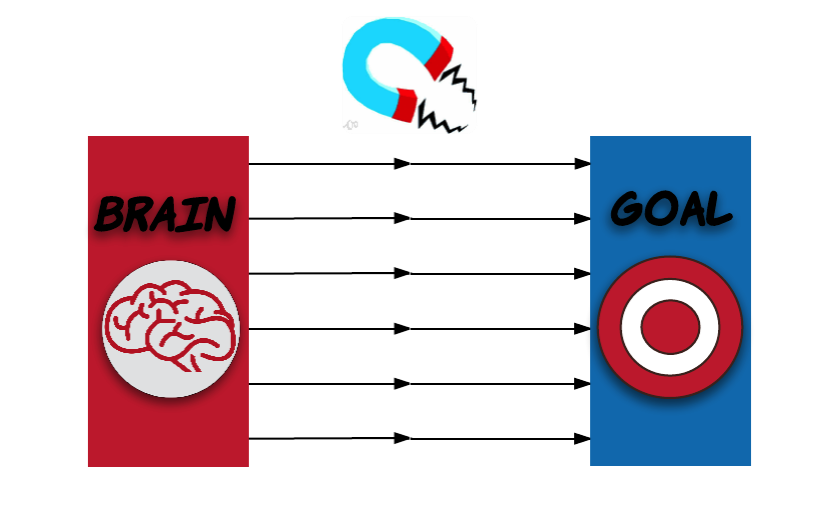
It works even better if you reiterate the goal at the start of the meeting so the brains of all the participants are tuned into the PURPOSE of the meeting. It’s like a magnet. The GOAL is one side of magnet and the people’s brains the other side of the magnet. Now the magnetic forces align.

Magnetic Attraction

Often when I write the goal it requires me to dig deeper so I actually do some thinking and PLANNING. Within 1-5 minutes I clarify my intentions for myself and for others and my return on investment will be much greater than the time it took to do the hard work of thinking.

People don’t like wasting time in meetings, but when you put together a 5-minute meeting plan and you execute that plan and you get the necessary buy-in and collaboration with multiple people, you really create a win-win.

In fact, I consider holding and conducting meetings as a productivity enhancer because I can actually get a high level of collaboration and alignment from group sessions.  When you have strong and capable people working on complex projects, you might need more meetings to get alignment. But you don’t want meetings that result in throwing around random off-topic ideas or bringing up the baggage of how, “it didn’t work last time we tried this, so it’s doomed to fail this time."  

You need to get the creative energy FOCUSED on solution-oriented thinking. The GOAL will guide you to that end. Facilitation training can also be very useful. Read more about that skill in a full-scale facilitation process, “Change Your Meetings and Change Your Life with Meeting Facilitation (aka Meeting Magic).”

Please let me know the outcome of your experience using the “Goal:…” statement in your meetings.  

Wednesday, February 10, 2016

On the Journey of Productivity and Excellence

It was my junior year in college.  I will never forget the lesson.

I did something that solidified one of my life principles: Leverage.


At Colorado School of Mines in Golden, Colorado I took an algorithms class and the major assignment was to create visualizations of sorting routines as they ran.   The idea was to start with a list of few hundred names and then create a plot on the screen that showed how they moved from chaos to order during every step of the process.

As a visual person I loved seeing the graphics on the screen move as each piece of the puzzle fell into place.  It was like Neo in The Matrix … seeing the patterns and knowing that they made sense.

Every few class periods the professor would assign a new algorithm to the process.  Near the end of semester, the professor assigned the grand finale:

Pull all the sort algorithms together and create a single application so that you can upload a single set of data and interactively select any algorithm and watch it run.  The application should return to the main menu and allow a person to again select another algorithm and watch it run.  Rinse and repeat.

There was lots of groaning throughout the class.  Many people anticipated weeks of spaghetti code combined into one big pasta dish that would turn out looking like ten different Italian dishes run through a blender.

Earlier in the semester I figured out I could design a common interface for all the algorithm projects and reuse it for each subsequent assignment.  After all, I’d have to test all the projects, so why not use a common interface and automate the test.

The final project was completed in a few days and it took me very little effort.
A few hours of good design resulted in an easy semester of programming and an even easier final project.  

The professor pulled me aside after he finished grading the final project and he said, “I really liked how you wrote that project.  If I were a software company, I would hire you.”  I thought that was pretty cool.
Putting my 20 year-old elation aside, the real lesson I learned was how to maximize my Leverage.  

Thoroughly understanding the problem creates Leverage.

Good planning creates Leverage.  

Leverage allows you to do something once and have it work for you over and over.

It’s perhaps a little cliche, but Archimedes said it right, 
Give me a lever long enough and a fulcrum on which to place it, and I shall move the world.”

Leverage is a tool available to everyone.  Like any craftsman, you must explore and practice to find the one that works for you. Here are my Productivity levers…
Every year I re-read or re-listen to these books to refresh myself on the concepts and practical tips for a successful life.  Like a ship constantly adjusting its course on a long journey, the principles and practices found in these books help me navigate the ocean of life and reach islands of success throughout my journey.

What is your #1 productivity lever? Please leave a comment about either your biggest productivity challenge or your biggest productivity lever?

http://www.steveteske.com


Saturday, December 26, 2015

Always Enter a Meeting with a Goal, Always Leave a Meeting with a Decision

One of the biggest time wasters in the corporate world and even in your personal life the delayed decision making.  Interestingly, the cost is not just dollars, but also in dreams and goals.

One of my most frustrating experiences is having a meeting twice when it could have been done once.  I either facilitate or participate in 1 to 2 meetings per day.  On a monthly basis I facilitate a couple business unit status and brainstorming meetings. In some cases, there is a clear path that is desired and other times there is a very vague notion of the future.

When there is a clear path, it is time to seize the moment and move forward. It’s at this point that many people begin to pause and mentally stutter about moving forward.

There is art and science in the timing of decision and I find making decision quickly seems to result in getting to your goals sooner.

When I enter into a meeting, I usually have the word, “Decide” in the meeting goal so that people are pre-programmed to know that we intended to put some down in writing and agree. Here are some examples:
  • Review Architecture Options and DECIDE on Architecture for Initial Release
  • Review Subcontract options from vendors and DECIDE on which vendor to go with
  • Review and Update Development Process proposal (DECIDE is implied with the word “Update”)
The Better Meeting Magic Deciding … always leave with a decision.


Tip #1: Leave time at the end of your meeting (10 minutes) to review your meeting and make sure you’ve achieve your meeting GOAL

If you’ve followed my series of posts from the beginning, “Change Your Meetings and Change Your Life”, you are aware that having an effective meeting is not by accident.  You must create an environment for effective collaboration and decision making.

As part of your meeting plan, give yourself time to review the goals at the end of your meeting. Review the “GOAL” statement in your own mind and then ask others if they agree that you’ve met the goal.

Tip #2: Use multi-voting to DECIDE on the 1 or 2 things.

Multi-voting is one of my favorite decision making tools.  I use this all the time to help decide among a set of well understood options.  To make DECIDING easier, you needed to complete BRAINSTORMING (see my article, "In a Meeting What is Best for Creative Problem Solving? Total Freedom or Well Defined Process?”) and NARROWING (see “How to Find Great Ideas from a Massive Sea of Brainstorming Information”).
Here’s the process of multi-voting:
  1. Pick the number of results that you to get out of the process…you want to start working on 1 idea, then give each person 1 vote.  Or you want to get the top 3 ideas, then give people 3 votes.  This process works best when you want start working on 2 to 5 ideas 
  2. If you have sticky dots, had out the number of sticky dots equal to the votes to each person.  You can pass out markers if you don’t have sticky dots and then use the honor system to insure people count their votes correctly.
  3. Have each person vote by placing a dot or mark on the sticky note or idea on the white board.  
  4. Each person vote distribute their votes any way they like (e.g. all dots on a single item or 1 dot for each of their priorities).
  5. When finished, you will usually have a majority of the votes on the item that people think is the highest priority.
Caveats: If you play this game with really smart people, you should make them vote privately, because I’ve had people game the system in the past by waiting for everyone else to post votes and then the tricky smart person stuff one particular item 5 votes and thus threw of the entire process.

Tip #3: Send the meeting minutes and a summary of decisions as quick as possible


  • Take pictures of the whiteboard and/or wall with sticky notes, dots, markers etc.  
  • Include all this information in a word document or on SharePoint site or OneNote page or Wiki or Confluence page. 
  • It needs to be accessible for everyone.
  • Make sure you summarize the major decisions.

I’d like to hear how you facility the decision process? What works for you?

Read more at http://www.steve.teske.com

Thursday, November 26, 2015

Turn Tough Meetings into Successful Outcomes With an Excellent Plan and Meeting Kickoff That Creates Focus

Picture yourself in a meeting room.  You arrive early and people start trickling in.  It’s a few minute pass while you all   Who will do the most talking?  Who will be THAT GUY who won’t agree with anything. Or THAT GIRL who won’t stop talking even though nothing relevant is being said.

This is how things start in many of your meetings.  Put aside the bliss of the “status” meeting where you just sit and consume information.  That’s not the meeting we are talking about.  We are talking about the meeting that really needs people to express incredible creativity. The meeting where people need to solve those intangible problems that people keep saying, “we should do that some day.” 

Energy and time are needed to solve tough problems in a meeting.  Actually you need ENERGY and TIME and FOCUS.  With the proper start of each meeting you have a chance to give participants a turbo boost of all three of those things.

Energy


Energy comes from expressing a goal and instilling into others the sense of urgency to reach the goal. 


In a previous article “Change Your Meetings and Change Your Life,” I introduced Better Meeting Magic, a way to change the culture and productivity of a team, department, division or company that embodies the spirit of collaboration, inclusiveness and focus.

Then in a subsequent article, "Improve Your Focus and Improve Your Team's Performance in Meetings", recall that Planning Is Indispensable because you have created a runway to achieve high altitude performance during your meeting.  You created a meeting GOAL.  You included the GOAL in the invitation. And now you are going to paste it on the wall in the biggest font you can find.

This is step 2 "Opening" in the Better Meeting Magic.   You will open a meeting with some administrative tasks, setting expectations and preparing the participants for an excellent collaborative experience.

Tip #1: Post the Meeting Goal for High Visibility

On an 11”x17” paper print “Goal:  Decide on the Marketing Strategy and Create a List of Step to Achieve It”.  You can also write on a flip chart or even on whiteboard. It must stay as a focal point for the whole meeting, so make sure whatever surface you use to present the goals stays visible and does not get erased.  Make it public so everyone can see it and read it. You might need to revisit the goal during the session. 


Tip #2: Post Meeting Rules for Everyone to See

Also on an 11”x17” paper print “Rules: …”.  Same operating principles apply to the Rules sheet as applied to the Goals sheet.  Make it visible and keep it posted throughout the duration of the meeting.


Reiterating and publishing the goals ENERGIZES the participants because they know that this meeting will not waste time and that achieves the criteria of successful meeting key #1.  A goal also FOCUSES the participants and achieves the criteria of successful meeting key #2.  And if you start on TIME and end on TIME, you will achieve the criteria of successful meeting key #3.

Time

Allocating the correct amount of time to a meeting is essential and must be part of the planning process.  But now that you are in the meeting, you have to keep yourself and the whole party on track to achieve the goals. Part of this journey is starting on time. The end of this journey will be better appreciated if it ends on time as well.

Focus 

FOCUS is the essential ingredient to make a meeting work and you’ve started off with right foot forward if you’ve posted the Goal(s) and Rule(s) and started on time.  The rest of the meeting is going to be better because you know your purpose.  Just like an aircraft flying from Los Angeles to New York that will fly slightly off course 99% of the time, you too will continue to adjust the course of the meeting ever so slightly when you see things getting off track.

Focus! Focus! Focus!

Put time into understand the purpose of the meetings. Then post Goals and Rules.  Then monitor and gently correct.

Tip #3: Make a Parking Lot for Off Topic Ideas

I almost forgot the Parking Lot.  This is a jewel and you cannot forget to put this up on the wall as well.


In order to keep the meeting on track, explain that you have a Parking Lot and put notes into that space. Write on whiteboards or flipcharts or post sticky notes for any items that don’t fit into the context of the meeting, but are burning issue for some of the participants.  Be sure to follow-up on this items.

Do you have an interesting story about how a meeting went so off course?  Please write a comment and share your story.