Showing posts with label Facilitation. Show all posts

Wednesday, June 1, 2016

Improve Agile Meeting Productivity 2x-5x

Let’s say your personal productivity is awesome. Perhaps it’s not perfect, but it’s pretty good. You have habits that are working well. Perhaps you’re waking up, getting some exercise, reading, and working on your big goals.  At work you may even have your e-mail inbox under control.

But your work environment is chaotic and your meetings are wasteful. See if you find anything familiar in this typical scenario.


Example of a Wasteful Meeting


Meeting Idea


Your boss says, “Let’s decide how to create an architecture for the next generation of our software product. I’ll schedule a meeting to discuss the architecture.”

Don’t get alarmed yet, but NEVER have a meeting to DISCUSS something. Only have meetings to DECIDE something.


Meeting Invite


The meeting announcement goes out saying, “Future Architecture Discussion.”

The body of the meeting says, “Let discuss the future architecture of our application that will support the upcoming requirements.”

Now you should be a little alarmed. This meeting is not looking like a good use of your time because there’s no definitive deliverable. 

Meeting Time


The meeting time arrives and all the very opinionated, smart, capable, driven, and highly effective people arrive in the room and take seats around the table. For the purposes of this (nearly historically accurate) example, let’s assume there are 6 people attending the meeting.

If everyone arrives roughly on-time, you have already saved many minutes of the start-stop-restart cycle.

When the meeting host settles down in his or her chair WITHOUT a note pad and only a cup of coffee in hand, you should begin to raise the alert level to DEFCON-3.

This style of meeting will result in NO MINUTES and possibly NO DECISIONS. 


Meeting Flow


During the meeting there is a flurry of different topics that come up.  The meeting starts with architecture, but shifts subtly to some interesting topics:
  • What if the marketing guys have got it all wrong?
  • What if the CEO won’t fund the architecture?
  • What if the current application technical issues cause the team to spend 50% of their effort fixing bugs instead of creating the new architecture?
  • Etc.
These are interesting but they’re enticing, emotional, and USELESS in regards to the architecture discussion. 

Alert raised to DEFCON-2.


Meeting End


Near the end of the meeting, people begin to look at their watches saying they are have another meeting to attend. Nothing has been written down.

Like nuclear war, once the missiles are launched it’s too late to rescue this meeting. Raise the alert status to DEFCON-1 - Maximum alert.


Is There Another Way?


The example above is likely to resemble some of the meeting norms where you work. Inefficient and ineffective meetings might be a cultural norm, but it’s not the way it has to be. 

With a little attention at each step in the meeting process you can improve the effectiveness and increase the collaboration in your daily meetings.

Meeting and cultural norms

Example of a Productive Meeting

Meeting Idea with a Deliverable


The boss suggests that you gather the technical leaders and determine the next steps in the architecture evolution. She says, “Can you get with the team and develop a roadmap for the architecture?”

You’re empowered to create a ROADMAP. This is the deliverable from the meeting.


Meeting Invite With a Purpose


You think for a few minutes and decide on the goal for the meeting. “Create and record a roadmap for application architecture with a 5-year horizon.” 
In addition, you come up with a rough agenda.
Agenda:
1. Review the marketing requirements
2. Record highest risk items
3. Create a list of architecture changes necessary to meet the business goals.
A meeting invite with a purpose can result in 2x improvement because it primes the brains of all the participants to think about the problem ahead of time.
With a goal, you can take your 2x productivity to the bank by shrinking your meeting length by half.  

With a goal and agenda, you could find a 3x impact.  A meeting that normally takes an hour could take 20 minutes.  The meeting ends when you’ve reached your defined goal and know how to get to the goal with a written plan.


Meeting Time With a Prompt Start


Depending on the business norms in your company you’ll experience very different meeting norms: for example, habitual tardiness to meetings. One way to shift business norms is to start on time.

In one meeting I hosted the attendees arrived on time, but were quite talkative about numerous subjects. In order to move the meeting forward, I said, “I can make your Friday shorter if we start on the review right now.” And then we got down to business.


Meeting Flow With a Plan


When it comes to meetings, there’s nothing like a good plan. A colleague  quoted once, “Never attend a meeting that you don’t control.” Perhaps that’s a little extreme, but I would say you should always have a plan for the meetings you host, including slides and/or a facilitation plan.

At the minimum I create Powerpoint slides to keep the meeting focused on a specific outcome. When you have a representation of the goals, people have a much easier time keeping their focus. 


Meeting Flow With a Turbo Charged Plan


Since people are very visual and actually engage with more energy when standing, consider using sticky notes or a whiteboard. Sticky notes are especially effective because they can be moved and re-arranged easily during a discussion.

Copy paper and blue masking tape are also very useful if you have information prepared before hand.  

To increase the effectiveness of sprint grooming or planning meetings I often print out sprint backlog titles to tape to wall. Then I have the team create a task breakdown using sticky notes that are placed in order under the backlog item. I use the Post-It Plus application to take a picture of the the wall.  The application recognizes eat individual sticky and exports the sticky notes in several formats. Excel is useful when I have a large quantity of notes. I then get the notes transcribed.


Meeting End With Closed Loops


At the end of the meeting you should have the following.

1. Actions recorded
2. Decisions recorded.

No matter what kind of meeting you’re holding, the end game must conclude with decisions and actions recorded.


When You Need a 5x Strategy


Under normal meeting circumstances a goal and agenda are sufficient to succeed. But sometimes a meeting deals with highly emotional or widely debated topics that need a 5x strategy. Without a 5x strategy, you’ll lose hours of time and potentially create even more tension.

Productivity of 5x is possible and realistic when you come prepared with a detailed facilitation plan that includes well planned activities. The plan should include strategies and activities for:
  • dealing with peoples biases (mental or emotional baggage) 
  • effective brainstorming
  • taking large quantities of creative input and move it towards a decision
  • keeping the level of engagement high so that the participants keep their energy and intellect focused on the topic
  • engagement during the meeting with boundaries
  • any needed follow-up
The article “You Can Have Better Agile Meetings” provides a overview facilitation flow. 
If collaboration attempts fail and the emotions or topics remain unresolved, the most common alternative is to call in the higher authority to resolve the issue.  

This is a weaker approach that could result in temporary solution, but with a high probability that the parties will find “insurmountable issues" with the top down decisions as soon as the slightest obstacle is encountered.

Conversely, the gains from a 5x strategy can achieve a lasting consensus and full buy-in from your team members.

Please leave a comment about the most debated topic that needs to be solved in your work place? 

Wednesday, May 4, 2016

How to Learn a Productivity System Part 3: Planning

“Soldiers, sailors, and airmen of the Allied Expeditionary Force! You are about to embark upon the greatest crusade toward which we have striven these many months. The eyes of the world are upon you.” - Dwight D. Eisenhower, supreme Allied Commander 

These were the words spoken before the D-Day invasions were executed.

In light of the immense planning that was required to pull off this amazing multi-nation, multi-front, humungous battle for freedom, another famous quote is also realized.
“Plans are worthless, but planning is everything” - Dwight D. Eisenhower.

D Day Invation

At home and at work I believe this quote about planning to be spot on.  It’s interesting to see how your brain works differently in a meeting or during an activity if you’ve done some planning versus when you wing it.


Consider Two Scenarios


Scenario #1: You receive an e-mail meeting invitation from a colleague titled, “Acme Contract” and the meeting is schedule for tomorrow. The body of the invitation says,”-Thanks.” You’re aware of the Acme Contract and you know you’ll be working on the Acme contract. If fact, you have some very specific feelings about the Acme Contract and how it will impact you and possibly others on your team.

You show up to the meeting and your colleague says, “We’ve got to update the contract and bid based on new input from my boss.  I’m showing the spreadsheet on the overhead. 

Let’s update the info to reduce the overall cost.”
Scenario #2: You receive an e-mail meeting invitation from a college titled, “Acme Contract Updates.”  The body of the e-mail says,

Goal: Review and Update Acme Contract Cost and Assumptions to Reduce Overall Cost.
Agenda: 
1. Review current contract and bid.
2. Re-assess assumptions
3. Update bid based on new assumptions
See attachment for current contract and bid assumptions.

You show up to the meeting and you know what the outcome is. Your brain has already been working subconsciously on new assumptions and ways to save costs. Your brain has a slight edge over Scenario #1.  

Ask yourself this question, “Assuming a 1 hour meeting, how much time is saved in Scenario #2 over Scenario #1?”

What do you think? 5, 10, 15, or 30 minutes?

If there are 3 people in the meeting you would minimally save 15 minutes total for your company and 5 for yourself.

If there are 5 people in the meeting and you save 30 minutes, you just saved 150 minutes for your company and 30 for yourself.  WOW. Do you think it’s realistic to save your company 2 1/2 hours of time?  

Surprisingly, I think you’ll find it’s very realistic and practical. If you do this, you’ll be a hero among your peers and in the eyes of your superiors because you’re creating more value in less time.

You might be saying, “Sounds pretty idealistic and like it will take a lot of work to create that goal and agenda.” 


A Mechanism to Train Yourself to Plan


1. Commit to never sending a meeting invite out unless you have at least one sentence in the body of the meeting notice, The GOAL: “Goal: ……”


It will take 1-5 minutes to write this single line but you will ALWAYS recoup that time by saving a minimum of 5 minutes in every meeting you host.

When you write the Goal statement in your e-mails it will force you to think just a little deeper. 


2.  Always include a concrete outcome in the goal statement.  


You would not use “Goal: Discuss developing a new app” as a goal statement. The word “Discuss” is not a concrete deliverable. The real PURPOSE of a meeting is not to discuss something. The PURPOSE of a meeting is to come to agreement and record decisions and action steps.  

A better goal, then, would be, “Goal: Create a Development Plan for the New App.” Now I have a pre-defined output for my meeting. At least for myself I know what I expect to get out of the meeting. At the end of the meeting I should have a draft plan to get from zero to new application.  

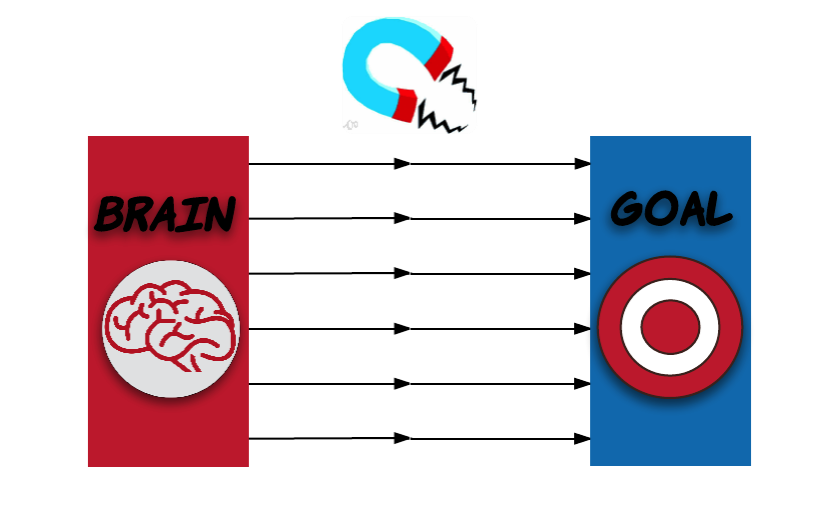
It works even better if you reiterate the goal at the start of the meeting so the brains of all the participants are tuned into the PURPOSE of the meeting. It’s like a magnet. The GOAL is one side of magnet and the people’s brains the other side of the magnet. Now the magnetic forces align.

Magnetic Attraction

Often when I write the goal it requires me to dig deeper so I actually do some thinking and PLANNING. Within 1-5 minutes I clarify my intentions for myself and for others and my return on investment will be much greater than the time it took to do the hard work of thinking.

People don’t like wasting time in meetings, but when you put together a 5-minute meeting plan and you execute that plan and you get the necessary buy-in and collaboration with multiple people, you really create a win-win.

In fact, I consider holding and conducting meetings as a productivity enhancer because I can actually get a high level of collaboration and alignment from group sessions.  When you have strong and capable people working on complex projects, you might need more meetings to get alignment. But you don’t want meetings that result in throwing around random off-topic ideas or bringing up the baggage of how, “it didn’t work last time we tried this, so it’s doomed to fail this time."  

You need to get the creative energy FOCUSED on solution-oriented thinking. The GOAL will guide you to that end. Facilitation training can also be very useful. Read more about that skill in a full-scale facilitation process, “Change Your Meetings and Change Your Life with Meeting Facilitation (aka Meeting Magic).”

Please let me know the outcome of your experience using the “Goal:…” statement in your meetings.  

Wednesday, January 20, 2016

Close the Open Loops: Keep Track of Your Meeting Outcome then Followup

As a parent I understand the extensive effort in following up on chores and tasks.  Its time consuming to audit the quality of a job after the bathroom has been “cleaned” by a teenager or the room has been “cleaned” by the middle schooler.

As a project manager keeping track of numerous commitments and an extraordinary number of moving parts is also on the order of difficult and time consuming. 

Recently I completed a key milestone for one of my projects. The project required the collaboration of multiple departments, multiple distributed teams and external contractors (including managed service partners for those of you who know what that is).  The gist of the project was to replace an aging database infrastructure with the latest hardware and latest release of database software.

The process took months of preparatory work and collaboration.  It started 3rd quarter 2015 and culminated in a successful cutover on 7 Jan 2016.

In order to make this happen I provide a lot of oversight and I facilitated numerous meetings. I highlight only a few of the key of meeting below:
  • 1 day facilitated session with consultant to create a new architecture
  • 1/2 day facilitated session to create a step-by-step plan for the upgrade
  • 2 hour facilitated session with IT security and networking team to identify all networking and security changes
  • 1 hour planning session for the week of the upgrade
  • 15 minute weekly meetings with external DBA consultant
  • 15 minute daily standup during the week of the upgrade
  • 2 1/2 hour cutover conference call with the multiple teams and external partners participating
  • (It went super smooth by the way)
This project required a lot of hard work by many technical folks and those technical guys deserve kudos’ for their efforts.  I’m highlighting the meetings because I am about to give some tips to on how to take these key meeting events and get the most of them through good follow-up.


In my previous article, “Change Your Meetings and Change Your Life,” I introduced Better Meeting Magic, a way to change the culture and productivity of a team, department, division or company that embodies the spirit of collaboration, inclusiveness and focus.
This installment is all about FOLLOW-UP:


Here are my tips to following up: 

Tip #1: Get the minutes out as fast as possible

To enable faster minutes capture, use visible formats such at sticky notes or a whiteboard. I describe some options for highly visual collaboration in the article, “In a Meeting What is Best for Creative Problem Solving? Total Freedom or Well Defined Process?”. 

When the meeting is done, you the following apps to take pictures and send them to yourself and/or the meeting participants.
  • Microsoft Office Lens - best for whiteboard with drawings
  • Post-it Note(r)  Plus - best for anything with post-it notes of any size and also 8x10 or 11x17 pieces of paper

Tip #2: Get the next step or meeting schedule as soon as possible

At work I use Microsoft Outlook for e-mail and meetings. When I get back from my current meeting and I need to schedule a followup meeting, I will do one of two things:
  1. Write an e-mail to myself to schedule the next meeting and put it into my GTD ‘!Action’ folder (I actually have Outlook rule that automatically puts the e-mails from me and to me into my !Action’ folder)
  2. or simply schedule the next meeting right when I sit down at my desk.

Tip #3: Make sure you have a good capture-processing-resolution system in place

I use Getting Things Done by David Allen as my capture-processing-resolution system.  If you read more about GTD, you’ll find it’s actually got 5 phases of processing for everything in your life. 

In the previous tip I hinted at my GTD system for schedule a followup meeting. I use that same system for capturing and executing all actions. I use David Allen’s suggested e-mail boxes called ‘!Action’, ‘!WaitingFor’ and ‘!ReadReview’.  I also take any date sensitive actions and create an ‘all day’ meeting on my calendar.  The ‘all day’ meeting shows on the calendar as a small banner for the day it’s due. To make it easy to create these calendar banners, I created a Outlook quick access rule to copy e-mail contents to calendar appointments, so I can execute this whole step in 1-click. 

In the morning and many times throughout the day and in the evening, I review the calendar, the !Action folder and !WaitingFor folder and make sure I follow-up and I ping other people to follow-up as well.

Close your Open Loops and Use good meeting practices coupled with GTD to succeed in your work and at home.

Having problems with follow-up?  Share our issue in the comments or send me an e-mail. I’ll be glad to talk about it with you.

http://www.steveteske.com


Wednesday, January 13, 2016

End a Meeting with The Confidence That Everyone Knows The Path Forward

Today I was in a meeting that was intended to be 15 minutes long.  It started late, about 6 minutes past the hour, and got off to a rocky start due to technical issues with conference software.  Many of the participants often get side tracked with deeply technical concerns or quandaries about corner cases.  In fact, I think it was probably about 20% focused on executing the project (the stuff I wanted) and 80% of the discussion was what-if scenarios or providing context for different meeting participants.

Interestingly, the meeting lasted about 25 minutes, and in percentages, the overage was about average for this group of very talented and highly responsible staff.  They have an incredible sense of ownership for their work and as a result, they want to know all the details of pretty much every decision. Especially when it comes to technical decisions that are near or directly inline with their sphere of influence.  Good folks.

Was this meeting wasteful? Perhaps.  But it was successful because I got a list of actions assigned to specific people and I scheduled a daily standup meeting to follow up and insure everything got done.  There was no ambiguity about what needed to happen or who was going to do it.  To me, leaving a meeting with zero or very little ambiguity is a sign of successful outcome.


When you terminate a meeting you need to put an end to ambiguity.  In Better Meeting Magic vocabulary this step is called CLOSING.  Read more about the whole Better Meeting Magic planning paradigm in the article, “Change Your Meetings and Change Your Life with Meeting Facilitation (aka Meeting Magic).”


Effective CLOSING removes three primary sources of ambiguity:

1) “What did we decide?” or “WHAT” ambiguity,

2) “Who will do it? or “WHO” ambiguity

3) “Will we discuss this again?” or “OPEN LOOP” ambiguity

Tip #1: Kill “WHAT” Ambiguity by Reiterating the Decision and Asking for Confirmation

Destroy ambiguity in every meeting by reiterating orally what you’ve decided to do and ask the participants to confirm the decision.  Example: At the end of the meeting you could say, “The goal of our meeting was to: ‘Decide on a database vendor’.  And I believe we’ve decided to move ahead with vendor XYZ to support our database infrastructure.  Did I capture that correctly?”

By reiterating the meeting goal and the decision, you will likely get the last minute ‘NO WAY’ or you’ll get everyone nodding their head.  If you have dissenting opinions, that’s good because you need to know where you stand before you leave the meeting with a false sense of doneness. If you have consensus, this decision is made and will likely stick.  

Tip #2: Annihilate “WHO” Ambiguity by Assign Actions to Specific People in the Meeting

Destroy “WHO” ambiguity by making sure you have a assignee on each action.  It's good to assign action in the meeting so the assignees can review the action and possibly ask clarifying questions before the team disperses.

This creates a more sticky sense of ownership.  A responsible assignee will try to understand the expectation through dialog.  An unwilling assignee will have the accountability of the group.

Add due dates to further eradicate ambiguity.

Tip #3: Short Circuit “OPEN LOOP” Ambiguity by Picking the Next Meeting Time Before You Leave the Current Meeting

Obliterate “OPEN LOOP” ambiguity by asking the participants whether the topic is closed or there are still more to address. As you develop skills in planning your meetings, you will likely see less carry-over meetings because your planning and time management will enable you to reach decision in a single meeting.

For details on good planning tactics, see the article, “Improve Your Focus and Improve Your Teams Performance in Meetings.” 

One of the most frustrating things in any business environment is to see good ideas die on the vine.  When everyone is busy and there are tough topics left unresolved, people feel weighed down and a natural response to “embrace the status quo”.  

In simple language, “embracing the status quo” is just failing to put enough energy into following up on the tough topics.  In reality it doesn’t require supreme amounts of energy to conduct a follow-up meeting, but the emotional resistance is high.  

When I’m heading for bed and I know I’ll be getting up early the next day to take a run in freezing cold weather I can prime myself for success by putting out my running clothes and running shoes on the floor of my bathroom.  Somehow this routine removes some of the friction of getting up early and taking a run.  

Use this priming strategy to overcome the “OPEN LOOP” ambiguity by making the next meeting plan during the current meeting.  

BTW, if you want to learn lots about how to deal with open loops in your personal and work life, read Getting Things Done by David Allen. His productivity strategy will help eradicate ambiguity in all corners of your world.

I’d like to know if you have applied any of these techniques.  Or perhaps you have some of your own.

Please write a comment about your best tools for overcoming meeting ambiguity.  

Or get in touch with me on my Contact page to talk about your latest meeting success.

http://www.steveteske.com

Saturday, December 26, 2015

Always Enter a Meeting with a Goal, Always Leave a Meeting with a Decision

One of the biggest time wasters in the corporate world and even in your personal life the delayed decision making.  Interestingly, the cost is not just dollars, but also in dreams and goals.

One of my most frustrating experiences is having a meeting twice when it could have been done once.  I either facilitate or participate in 1 to 2 meetings per day.  On a monthly basis I facilitate a couple business unit status and brainstorming meetings. In some cases, there is a clear path that is desired and other times there is a very vague notion of the future.

When there is a clear path, it is time to seize the moment and move forward. It’s at this point that many people begin to pause and mentally stutter about moving forward.

There is art and science in the timing of decision and I find making decision quickly seems to result in getting to your goals sooner.

When I enter into a meeting, I usually have the word, “Decide” in the meeting goal so that people are pre-programmed to know that we intended to put some down in writing and agree. Here are some examples:
  • Review Architecture Options and DECIDE on Architecture for Initial Release
  • Review Subcontract options from vendors and DECIDE on which vendor to go with
  • Review and Update Development Process proposal (DECIDE is implied with the word “Update”)
The Better Meeting Magic Deciding … always leave with a decision.


Tip #1: Leave time at the end of your meeting (10 minutes) to review your meeting and make sure you’ve achieve your meeting GOAL

If you’ve followed my series of posts from the beginning, “Change Your Meetings and Change Your Life”, you are aware that having an effective meeting is not by accident.  You must create an environment for effective collaboration and decision making.

As part of your meeting plan, give yourself time to review the goals at the end of your meeting. Review the “GOAL” statement in your own mind and then ask others if they agree that you’ve met the goal.

Tip #2: Use multi-voting to DECIDE on the 1 or 2 things.

Multi-voting is one of my favorite decision making tools.  I use this all the time to help decide among a set of well understood options.  To make DECIDING easier, you needed to complete BRAINSTORMING (see my article, "In a Meeting What is Best for Creative Problem Solving? Total Freedom or Well Defined Process?”) and NARROWING (see “How to Find Great Ideas from a Massive Sea of Brainstorming Information”).
Here’s the process of multi-voting:
  1. Pick the number of results that you to get out of the process…you want to start working on 1 idea, then give each person 1 vote.  Or you want to get the top 3 ideas, then give people 3 votes.  This process works best when you want start working on 2 to 5 ideas 
  2. If you have sticky dots, had out the number of sticky dots equal to the votes to each person.  You can pass out markers if you don’t have sticky dots and then use the honor system to insure people count their votes correctly.
  3. Have each person vote by placing a dot or mark on the sticky note or idea on the white board.  
  4. Each person vote distribute their votes any way they like (e.g. all dots on a single item or 1 dot for each of their priorities).
  5. When finished, you will usually have a majority of the votes on the item that people think is the highest priority.
Caveats: If you play this game with really smart people, you should make them vote privately, because I’ve had people game the system in the past by waiting for everyone else to post votes and then the tricky smart person stuff one particular item 5 votes and thus threw of the entire process.

Tip #3: Send the meeting minutes and a summary of decisions as quick as possible


  • Take pictures of the whiteboard and/or wall with sticky notes, dots, markers etc.  
  • Include all this information in a word document or on SharePoint site or OneNote page or Wiki or Confluence page. 
  • It needs to be accessible for everyone.
  • Make sure you summarize the major decisions.

I’d like to hear how you facility the decision process? What works for you?

Read more at http://www.steve.teske.com

Wednesday, December 2, 2015

Change People's Preconceptions and Prejudice into Powerful Learning Activities in Your Toughest Meetings

Dread!  That is the word that describes my feeling about attending some meeting. Recently I was asked to facilitate a meeting between IT and a business unit to discuss a how to modernize a development network. The two departments have a long history of strife, frustration, finger pointing and verbal sniping.  You could easily say that this meeting was one to dread.

In this article I'll address you how to turn dread on it’s head and sew the seeds of cooperation. Applying the third step of Better Meeting Magic, Bias Check, will create a more collaborative interaction among antagonistic teams or really any group of participants that have a history of discord.

For further context on Better Meeting Magic, see the articles on “Planning” and “Opening.”

This article is focused on Step 3: Bias Check


Why Do I Need a Bias Check?

  1. People need to vent their emotions.  Venting emotions in a meeting setting usually creates discord because the venting usually has a target person or audience which is personified as the Bad Guy or a the source of the trouble.
  2. People come to meetings with a fixed mindset about a topic.  Humans have a tradition of coming up with ideas and getting attached to those ideas.  So when you put a few humans in a meeting room and they are all attached to their ideas, it can be difficult to come to a consensus

Tip #1: Try to encourage silent exercises that involve writing or physical movement


If individuals come into a meeting with a lot of charged emotion, the last thing you want them to do is start talking out-loud. The talking part is not so bad, but the unfiltered words that come out can create early emotional damage and set the meeting on a precarious edge.

A good strategy for starting this meeting might be to have individuals agree on a set of meeting rules (how they will behave) and then pepper the meeting with writing and physical activities right from the start. These type of activities keep a person’s 'executive' brain involved instead of their more primitive 'mid' brain.

Once you get people THINKING they can usually stay on track and avoid EMOTING.


Tip #2: Use “Hopes” and “Fears” exercise


With this exercise, you gather will important personal perspectives from the participants and those perspectives will be shared with everyone in a non-threatening way.

SIDE NOTE: You must have large sticky notes. Basically every exercise I use requires 8”x6” sticky notes. And you need participants to use markers not pens or pencils.  I MEAN IT. Don’t scrimp on this because if you choose small sticky notes or pens, then no one can read the material and you will just frustrate everyone.  If someone starts writing with pen, I always interject and require they use markers. And I always bring an ample supply of large stickies and markers to meeting. 

  1. On a couple of sticky notes or a whiteboard write two headings: “HOPES” and “FEARS.”
  2. Give a small stack of 8”x 6”sticky notes and a marker to each participant.
  3. Instruct the participants to write at least one sticky note (only one idea per sticky) for each heading and post it on the wall or whiteboard.  Participants can write more than one, but they at least need to write one HOPE and one FEAR.
  4. Once all the notes are posted go to the wall, walk through every sticky note and allow the person who posted the note to add a couple sentences of clarification so there is universal understanding about the posted thought.  This might sound time consuming, but compared to an uncontrolled heated discussion it’s very small.  And it typically cuts to the heart of an issue and  help you and others guide the rest of meeting in productive ways.


What Does this Achieve

  • Everyone’s got to vent.  It’s important and people want to say their piece and be heard. 
  • Writing on paper encourages thinking vs. emotion.  Because the instructions included writing before talking, individuals think about their hopes and fears before expressing them and in doing so they tend to use good filters instead of a gushing unfiltered emotional responses.
  • Understanding is increased. Very quickly everyone in the room becomes aware of how people are thinking and where they are coming from.  And it happened without drama.

Tip #3: Use “Walk the Line” exercise


For topics with diametrically opposing views, this exercise is fantastic to allow people to express their view without getting into a long debate.

This exercise requires several feet of linear floor space and some blue painters tape. 

  1. Place a strip of blue painter’s tape in a straight line on the floor (minimum about 10’ long and probably no more than 20’ long depending on the number of participants).
  2. Using your prepared questions, ask each participant to stand on the line where they think they agree with either point of view.

  3. a.     Sample: “The far end of the line represents the statement, “company culture dictates how meetings operate.”  The near end of the line represents that statement, “company culture has no impact on how meetings are run.” Please stand on position of the tape line representing where it represents your belief within these two perspectives.  Some of you might say this question is a no brainer.
          I used this recently in training session and the results were very revealing.  Many people who I expected to stand on one end of the line, where very solidly on the opposite end of the line. Sometimes the learning that you can achieve with this exercise will surprise you.
    b.     Sample: “The far end of the line represents the statement, “teams work best with a strong single leader.”  The near end of the line represents the statement, “teams work best when self-directed.” Stand on the line where it represents your perspective.

  4. After each person has picked their spot on the line, ask each person to describe their perspective.

What Does this Achieve

  • Everyone want to be understood. It’s important and people want to know that others can appreciate their perspective.
  • Requires people think through their perspectives before they express their opinions.  This exercise helps people evaluate themselves and take a moment to consider their motives.  It’s not a counselling session, but just a few moments can help people become less emotionally and more contemplative. 
No one is inclined to check their bias at the door, but these simple activities will keep meeting participants thinking and sharing.

What was the most difficult meeting you’ve ever attended?  What went wrong?  Please leave a comment and share your thoughts.

Wednesday, November 18, 2015

Improve Your Focus and Improve Your Teams Performance in Meetings


Today I almost went batty in a meeting.  It wasn’t just me, but one of my colleagues almost went batty as well.  Why? There was disconnect on the type of information that we needed to get from participants.  Other participants were wandering from topic to topic and could not constrain themselves to find the core purpose of the dialog. I looked at my colleague and I saw the strain on his face was barely contained (he was trying to maintain a professional posture).  The person currently talking had gone down a bunny trail of technical details that sounded more like a R2-D2 beeping and chirping to C3PO.  The purpose of the meeting was to inform the product owner how to make a decision about a couple different features in the upcoming release. The talker had completely lost touch with the goal of the meeting. I held my hands and requested a pause from the stream of consciousness monologue.  I reminded the team of the meeting purpose and we began anew with a better context and refreshed understanding of our GOAL.


In layman’s terms the bad behavior described above is called lack of meeting focus.  FOCUS is the root of productive personal and collaborative efforts at work and at home.  FOCUS enables people to reach a new state of productivity that some call FLOW.  FOCUS in meetings enables all participants to police themselves and police others so the meeting can make rocket propelled progress toward the GOAL.

The GOAL of a meeting is really the key aspect of meeting planning.  It’s the core of a productive person’s arsenal against distraction, negativity, bias, closed mindedness and unimportant topics.

In my previous article, “Change Your Meetings and Change Your Life,” I introduced Better Meeting Magic, a way to change the culture and productivity of a team, department, division or company that embodies the spirit of collaboration, inclusiveness and focus.

The diagram below repeats the Better Meeting Magic flow. This article describes the “Planning” component in depth. In fact, I've already introduced the most important aspect of planning: DEFINING the GOAL. 

The Goal

As mentioned above the biggest factor in making a meeting productive is defining the outcome of the meeting.  In Stephen Covey’s seminal work, 7 Habits of Highly Effective People, this is called “Habit 2 : Begin With the End In Mind.”  This powerful mechanism to challenges your brain to think about the outcome you would like.  Often a meeting is schedule because you know you need to talk about something that is blocking progress or causing friction or some collaborative decision needs to be made.  The meeting sponsor is often consumed with resolving the nagging issues, but sometimes neglects to define the core issue that must be decided before the meeting ends.

Tips for Setting a Goal: 

Tip #1: Make a goal for every meeting


When you create a meeting with your calendar application, stop before you send it and make sure the first line of the meeting description contains this line: “Goal: <fill in outcome here>”.
Force yourself to NEVER send another invite without a GOAL at the top of the calendar invite.

Tip #2: Keep your meeting goal concise


When you define the meeting Goal, make sure it has a measurable outcome.
You don’t need excess words in your life that don’t help you get to your destination.  You need explicit statements that guide the course of your meeting to a satisfying solution.

Tip #3: Make an artifact for every meeting


In the goal of your meeting, include the what artifact that you intend to create. You either want a “plan for marketing in a certain region" or a “vision statement for your department” or a “project plan with milestones for XYZ project”. 

Don’t sell yourself short and ask only for a “discussion”.  A discussion will always happen.  You want OUTCOMES.  ACTIONABLE steps.  Something that represents a DECISION or PLAN.   If you only have a discussion, you’ll have to meet again for a DECISION.  Don’t meet twice if you can meet just once.  In a later article, I’ll discuss other mechanisms to insure you manage your time and achieve your meeting goals.

Examples of good and bad meeting goals:

Good Goals:


“Goal: Discuss System Requirements for Project X and Create an Architecture Model.”

This is good because it has a specific outcome “Architectural Model.”  You might complete the meeting by finishing off a straw man architecture on a white board. Take a picture and e-mail the picture to everyone in the meeting.  GOAL ACHIEVED!

“Goal: Create an Actionable Marketing Plan for Product Y.”

This goal also has a specific outcome that you can measure, “Actionable Marketing Plan”.  You might end the meeting with a wall full of sticky notes that represent an ordered list of actions that the team will as execute.  You will take a picture of the wall, e-mail it to yourself.  Have your secretary transcribe it (or you can transcribe it) and send to everyone.  GOAL ACHIEVED!

Deficient Goal:

“Goal: Discuss the Needs of Customers in New York Region.”

While this may sound like a good goal, it does not end with an artifact.  In other words, what is the purpose of the discussion?  Do you want a sales plan?  Do you want to create a list of ideas? Do you want to create a demographic model? What is it that you want to ACHIEVE? A discussion can take place over lunch or over coffee or in the hall. You don’t want to waste time just discussing things, you really want to create something that can be instantly turned into a plan of action.

Let’s try again…

“Goal: Discuss the needs of Customers in New York Region and Create a List of the 10 Biggest Opportunities for 2016."

Now the discussion has a purpose.  It’s not a wandering meeting anymore.  The disciple of setting a GOAL is TOUGH.  This will challenge you to think a little deeper. You will spend a minute or two or three, but you will save many many minutes of people’s time and your own because you have a purpose in the discussion and everyone is now aware of that purpose.


If you know the end from the beginning, you’ll be a long way toward achieving your goals in a meeting.  It really only takes a couple moments to breath deep and put down your desired outcome.  Give this a try and see how it works to keep your meetings a little more FOCUSED.

When you think about creating a meeting, what things do you dread the most about conducting it?  Write me a comment and let me know.