Showing posts with label 7 Habits of Highly Effective People. Show all posts

Wednesday, June 8, 2016

Solve Conflict Among Team Members Before it Starts

Remember those weird times in junior high when you were the go-between for two people who were attempting to be girl-friend/boy-friend or perhaps there was a conflict that needed resolved and notes needed to be exchanged.

The two people who had the most to gain or lose would invite a 3rd party into the equation to pass along notes or information because they were not capable of  communicating face-to-face.

I can remember one time when I was involved in a relationship-defining event between two good friends.  I was their letter courier.  One of them would have some emotional trauma about their relationship and they would tell me and with their permissions I would tell the other.  Or one of them would write a short letter, explain their underlying emotions to me and I would delivery the note with some hints about how the other person was feeling.

This was heart wrenching for not just 2 people, but 3 people. This practice extended the force field of emotional pain beyond the 2 people and brought in extra’s to help the drama fester.  It was horrible and in this case resulted in a heart wrenching breakup.  One of my friends was a pretty massive weight lifter and the whole episode melted this rather hulking guy into a puddle of tears.

Office Conflict


In 7 Habits of Highly Effective People, Stephen Covey, write, “The cause of almost all relationship difficulties is rooted in conflicting or ambigous expectations around roles and goals. Whether we are dealing with the questions of who does what at work, how you communicate with your daughter when you tell her to clean her room, or who feeds the fish and takes out the garbage, we can be certain that unclear expectations will lead to misunderstanding, disappointment , and withdrawals of trust.”

Over the course of your time in the office you are likely to experience criticism. One of the sharpest pains I feel is when someone not in the room is being belittled.  When this happens I feel a strong need to stand up for the absent person and to provide perspective about the situation.  This can help, but it often does not solve the root mis-alignment of roles, goals and expectations between colleagues.

In the event multiple team members seem to be frustrated with another team or person, it’s time for teams to come together and sort out their problems together so they can be on the same page.

Just like in junior high story, there needs to be an intervention, except this time there is restoration and not a break up.

Enter Forming, Storming, Norming, Performing


In 1965 Psychologist Bruce Tuckman introduced the team development concept of Forming, Storming, Norming and Performing.
Forming storming norming performing
Other’s have added onto this concept and re-name the phases over time, but essentially there the stages of team development involve some amount of conflict, posturing and finally resolution and performance.
The emotional energy and conflict in the Storming stage eats away at productivity and in some cases key patterns of behavior can linger if Storming and Norming fail to results in a common purpose, goal and shared working agreements.

Storming


”..participants form opinions about the character and integrity of the other participants and feel compelled to voice these opinions if they find someone shirking responsibility or attempting to dominate. Sometimes participants question the actions or decision of the leader as the expedition grows harder…”  - Rob Chatfield, Leadership the Outward Bound Way.

Norming


“Resolved disagreements and personality clashes result in greater intimacy, and a spirit of co-operation emerges” - Rob Chatfield, Leadership the Outward Bound Way.

Performing


“With group norms and roles established, group members focus on achieving common goals, often reaching an unexpectedly high level of success" - Rob Chatfield, Leadership the Outward Bound Way.

As a team leader or project manager you want teams to accelerate through Storming and Norming and jump into Performing as quickly as possible.  

I’ve heard some people say that failure to pass through Storming will just delay the inevitable Storming to another day and cause the team to repeated regress before they can push through to Norming and Performing.  

In order for the team to establish the “norms and roles” the team must do the work of internalizing the goal(s)  and coming to some agreement on how they will interact with each other and the world around them.

Agile Chartering to the Rescue

Best way out is through

When creating a new team I want to provide some acceleration to get through storming and norming and into performing as quickly as possible.

My typical approach is two part meeting. First, define the problem that needs to be solved using, “Project Chartering” and then define the working agreements for the team using, “Team Chartering.”

Project Chartering provides an answer to WHAT.  
  • What are we building? 
  • What is the customer expectation? 
  • What are the key features? 
  • What are the milestone?
Team Chartering provides the HOW.  
  • How will we the team build this (What process)? 
  • How do we communicate with the business and marketing?  
  • How does the team delivery a solution to the customer?  
Admittedly there are a number of WHAT questions to ask in Team Chartering, but these WHAT questions are centered around the tactical working agreements and the teams process.
  • What should I do if I know I’m going to be late to team meetings?
  • What should I do if I reach a blocking issues?
  • What is the definition of done for our work product? (e.g. code reviewed, function tested, regression tested)
  • Who is responsible for moving an item to ‘Closed’ on the Scrum Board?
  • What should I do if I have a serious technical concern with an implementation?
  • Etc.
Some of these question seem pretty trivial. However, these are the kind of things that people stumble over in intra-team relationships.  I typically have a list of 50 questions that are both trivial and tough.

The length of chartering event depends on how many people are involved in the project.  Typically 6-8 hours is typical duration for combined Project/Team Chartering. If the team travels to a common location for a kick-off, book a day for this adventure and come armed with questions that the team needs to answer.  If the team is remote, you need to conduct this exercise with an online collaboration tool.  One of my favorites is Realtime Board (www.realtimeboard.com)

The time investment might seems high for a meeting with a lot of people, but this concentrated time results in outstanding team performance.

I’ve seen an unintended A/B test in my own work environment where one team was chartered and other was not.  The chartered team demonstrates higher collaboration with internal members and external stakeholders and delivers high output than the non-chartered teams.

You could say it’s just the people. I’ve seen too many examples of good people on non-performing teams that result in bad outcome and average people on good teams that result in outstanding outcomes.  

There is a high correlation between success and good team process. For a team to be effective the roles and goals and norms need to be well defined. 

You either let the team struggle to define the roles, goals and norms, or you can prime the pump and race through storming and norming and shift the team into performing.

Is there conflict or disagree on your current teams?  What is the biggest issue?

Please add a comment or send me an e-mail with the ‘Contact Steve’ tab.

Wednesday, May 18, 2016

How to Learn a Productivity System Part 5: Evaluate Life Dreams

When we think about productivity, we might think about being busy. That is an inaccurate view of productivity.

Productivity is achieving the most important things in life while avoiding the pitfalls of busy work and unproductive meaningless time wasting endeavors.


Productivity definition


So if you’re not yet keenly aware of the most important things, then that’s a very good place start. If you’re already aware of the most important things, then it’s good to revisit them to make sure you continue to move in the right direction.


Identifying the most important things


The following two exercises will help you identify some of your core desires in life. These exercises strip away things that are just about prestige and outward appearance.  

Yes, I want to own a Porsche 911, but it actually doesn’t appear on the core list of what I want to achieve during my living years. A Porsche cannot help me leave a legacy so it is not on the ‘got-to-have’ list.

Give these two exercises a try for building your core desires. If you already have a most important list, is it time to revisit it? Compare these exercise results to your existing list. Are there any differences? 

Why do you think some things made the list and others didn’t?

Time Travel to Your 80th Birthday


80th birthday cake

Envision your 80th birthday party. In this self-created visualization consider the location, the people, and the conversations you’ll have with those attending the party. You might need to close your eyes.

For me, I placed my 80th birthday party in my backyard and visualized my wife, my daughters, my grand-kids, my extended family, and my friends. I thought about my own character and legacy and the character of my children and grandchildren. 

Another addition to the exercise would be to visualize your professional accomplishments. It could be the successful sale of a business, the retirement from a company after attaining a certain leadership position, or perhaps the accomplishment of a significant goal that impacts the world.

In your visualization you can also think about:
  • Things still on your bucket list
  • Health goals
  • Travel
These results are the core of why you want to be productive.


To discover the real dreams in your life requires considerable introspection.

Write down your thoughts on paper or in Microsoft Word or Google Docs. Through the years I’ve added, removed or refined different aspects of it. Revisiting it annually moves me into a mindset where I can be more focused on the things that matter.


What Do They Say at Your Funeral?


In the exercise above, you envision a living legacy. You can see, hear, feel, and interact with your surroundings. This activity is a retrospective on your life.

There are several approaches you can take to talk about your non-living legacy.  

1.  Think about attending a funeral. It’s quiet and respectful. People are seated and someone is ready to speak at the front. But as you look into the coffin you realize this is your funeral. Consider who you would like to speak and what they would say.

2. Write your own obituary, but include more insightful things than just “survived by” and “lived at.” Go deep enough to bring out your legacy. What you want to leave after you pass on can be a serious guiding post to your core dreams.


Wow. That’s Different Than I Expected


There are some interesting things on my bucket list: trip to Italy, vacation in Tahiti, own a 1978 Porsche 911 Carrera RS, do an Olympic Distance Triathlon, watch the Formula One US Grand Prix Live, race a motorcycle, and many others.

In contrast, the two exercises resulted in things like “Happy, healthy, and wise children and grandchildren” or “a solid contribution in the market of productivity services that saved people millions of minutes over their lifetime.”

Evaluating your legacy gives a clue as to what dreams are truly the most valuable to you.  
Stephen Covey’s 2nd Habit in the 7 Habits of Highly Effective People is to “Know the End from the Beginning.” It’s a fancy way of saying do some planning.
When it comes to identifying your legacy, you’re doing meta planning. That’s effectively asking yourself what matters most and then providing a good solid answer.


The Core is Ready, Now What?


Once you’ve come up with a high, tactile version of your living and non-living legacies you’re ready to address the parts that make the dream happen.

Dreams can be hard to break down into parts because achieving dreams seems impossible. Dreaming doesn’t take any special effort or discipline, but reaching your dreams requires you to decompose the dream into small bite size chucks. For some concrete steps in breaking down dreams into goals and goals into plans, see the previous article, “How to Learn a Productivity System Part 4: Goals.” 


What About My Bucket List?


Don’t throw away your bucket list. Just know how it fits into the priority of things that matter most. 

For example, I had the dream of running a marathon. It was about 5 years of small steps that finally took me to the end goal in 2014. This happened to align with my desire to lead a healthy, fit life, so it didn’t take me in the opposite direction of my core dreams.

Please write a comment about what you discovered while doing these exercises. Did anything surprise you?

Monday, May 2, 2016

How to Learn a Productivity System Part 2: Actions

The past 2 weeks were a disaster for my productivity system.

As a software project manager I oversea about 10 projects.  A couple of the bigger projects have a release cycle of 2 weeks. Effectively that means there is no down time, there is no week off because one project releases on even weeks and the other project releases on odd weeks.  The other 8 projects are smaller research projects, which require more hand holding because they have significant risks and exposure to the company’s senior leaders.

One of my colleagues was off for 3 days so I did a little filling in. Then the following week we on-boarded a new project lead which, in the end, is going to help tons, but requires a bit of time to properly train a new person.

During this 2-week period my inbox went from 0 to 357. And my stress level pegged the ‘overheat’ mark so I knew I was loosing a few things along the way. The really urgent things didn’t get lost because some of my co-workers reminded me through e-mail and phone calls that they needed something (which is kind of embarrassing to be asked twice or three times).  

In the end, the urgent and important got done, the important but not urgent things got done, most of the urgent and unimportant things were ignored, and the not important and not urgent items were totally ignored.

For a really detailed description of the time management matrix, see the article “How to Save a Million Years of Time in a Life Time.”
Time Mgmt Matrix
How does one setup a system that manages his or her time, ensuring the important things done in life in spite of a continuous flow of stressful weeks?


One effective strategy: Train thy self


Take special-forces training as an example. In the series “Surviving the Cut” special operations forces training includes: 

 
  • Ranger School
  • Air Force Pararescue
  • US Marine Recon
  • Special Forces Divers
  • Navy Explosive Ordnance Disposal (EOD)
  • Marine Sniper


Another great training example series is “Navy SEALs: BUDS class 234.”


Even if you haven’t seen these series, most of us have an idea about the rigor of this type of training.

What’s interesting in many documentaries that I’ve seen (including books and post mission interviews), is the comments from special operations veterans about how they execute and survive in very stressful combat situations. Many veterans say, “I trusted my training”.


"I trust my training"


Isn’t that interesting.

In the heat of battle these amazing individuals with highly tuned senses and unwavering courage and amazing tenacity relay on TRAINING.  

This is a huge lesson for us. So let’s get trained in our daily routine so we can handle office stress. Here’s is the training you need to keep it going.


#1 Setup the Routine and Tools


Routine is key. Almost every day of the year I’m reminded how important it is to have 
routines or systems to keep on track. After listening to podcasts with very successful people, you quickly see they incorporate systems into their life in order to achieve their desired results.  

One of my favorite podcast of all time is Tim Ferris’ interview with Scott Adams (Creator of Dilbert). In the podcast Scott Adams expresses how critical his daily systems are to his success.

In “The One Thing” by Gary Keller he says, “The more creative a person is, the more they need a system.” You’d think it would be the opposite of that. But Keller argues that without a system you will just become distracted instead of productively creative.

Suggested routine for home

Wake up on time. It’s key to force this behavior. You’ve faced more pain in your life than getting up, so you can do it.

Refuse to read e-mail or watch TV or even read the news. Getting distracted from your routine is easy, so make sure you keep the first part of your day clean from tempting distractions.

Work Out. (I alternate between Yoga and Running). This is important to your longevity, mental health, and ability to feel good and have energy.

Eat breakfast with your family.  I’m big on pouring into my family’s life first thing in the day. It helps myself, my wife, and my kids enter the day with a mindset of thankfulness, thoughtfulness, kindness, and a spirit that is eager to learn.

Go to work.


Suggested routine for work


Look at your Calendar first. Your time is a map of your daily activities and you need to know the landscape.  Don’t be distracted by e-mail inbox.  Look to the calendar first.

Designate the biggest appointments you need to accomplish today as “all day” appointments. These are not meetings, they are deliverables that you need to make. (e.g. “Schedule training for the software team,” “Make sure that contract is signed by Pete,” or “Get the Bid to Joe for Atlas Project.”)

Put these on your calendar for each day of the week.  Many of these come in e-mails. I’ve created a special button in Outlook to create meetings from e-mails so I can plop these items into the calendar quickly.
If you get projects and direction through e-mails put as many as possible into the calendar to keep yourself aware of the non-meeting deliverables.

Put non-urgent emails into an “!Action” folder at the top of e-mail box.
If the action comes in some other way besides e-mail, a phone call or post-it note, write yourself an e-mail for those actions and either put it into your “!Action” folder or into an “all-day” calendar event on the proper day.  


Too many “all-day” events


Don’t get bogged down with too many daily assignments. Challenge yourself to reduce the number of daily events down to 3. Distribute the rest to different days or delete them altogether. Or perhaps put them in the “!Action” folder to deal with later.

If you are frantic at work, you won’t be able to become less frantic without FOCUS. FOCUS requires elimination. FOCUS is the result of shedding things so you can become immersed in one thing. 

Review and update appointments daily.


#2 Refresh Your Mindset at Every Possible Interval


It’s so easy to get distracted during the day. Each time I come back to my computer from a meeting or discussion with my colleagues, I look at the calendar first, then at my e-mail inbox.  


All Day Calendar First


Put the three big things at the top of the calendar. These are the “Big Rocks” in the parlance of Stephen Covey’s 3rd Habit: First things First. Stephen does a seminar exercise where he has a glass bowl half full of small pebbles and then another bucket with big rocks. The big rocks have labels on them like, “work out” or “time with family” or “write a book.” Stephen asks for a volunteer from the audience to come up to the stage and attempt to put all the big rocks into the bowl with the pebbles. People usually start stuffing the big rocks into the glass bowl only to find they won’t fit. There’s a lot of struggling to push rocks into the pebbles, digging around pebbles, and finally total frustration. The big rocks won’t all fit, unless…

Stephen Covey suggests the person pour out all the pebbles into the bucket, put in all the big rocks and pour all the pebbles on top.  

Guess what. It all fits perfectly. That is why the big rocks must be done first.


Meetings on the Calendar Second


What is the next thing on my calendar and how can i prepare for it?


E-mail Third


Triage the incoming mass of information.
If I spend more than 5 minutes on triage and think I’m getting distracted, I go back to All-day events on my Calendar to make sure I can complete the Big Rocks.

Now you have something that looks like a routine.  This is the training you can fall back on. We are lacking a little of the supporting philosophy, but that will come. Understanding the philosophy is often the next level of training. 

Please leave a comment or send me e-mail and let me know what Big Rock you’re struggling to get done?

Wednesday, April 6, 2016

How to Save a Million Years of Time in a Life Time

This is the last article in the “Save a Million” series — for now.  

All the articles have been building to this point.  In fact I have a big spreadsheet with the number of minutes versus time frame versus number of people required to meet each of these “Save a Million” goals.

But building exponential articles is not my goal.  Nor is building a nice spreadsheet.

Building a greater vision for myself and others is really the bottom line.

As so I’d like to introduce how to save a million years of time in a life time.
Every year I listen to my favorite books to keep my ruder steady.  I just finished listening to Stephen Covey’s 7 Habits of Highly Effective People.  It’s a very densely packed book where every other sentence is a quote I should paste on my wall or share in a blog post.

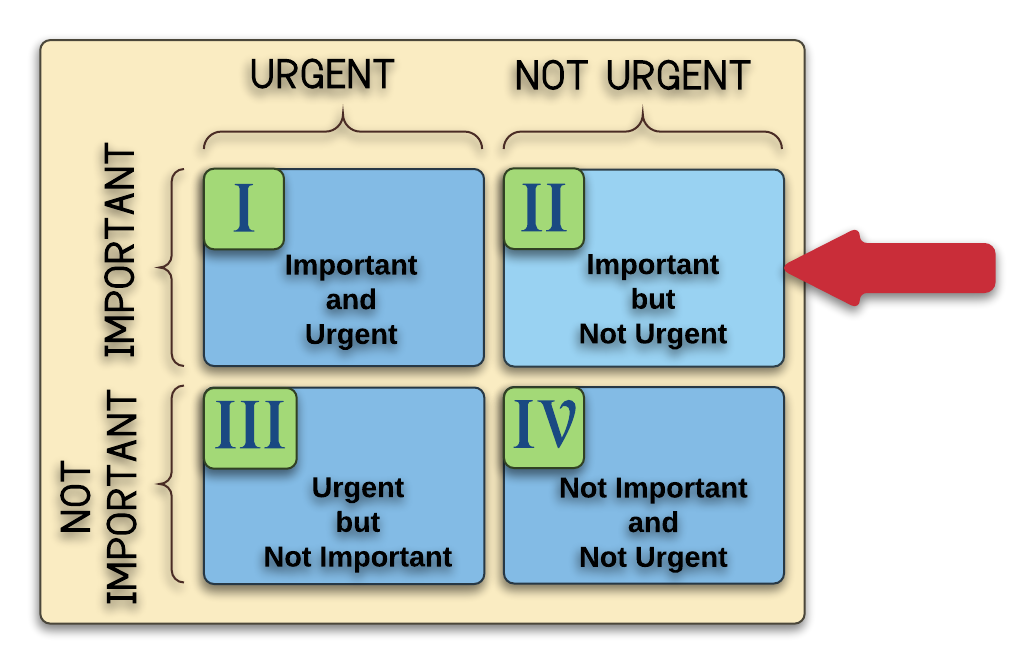
Covey’s center piece for discussing time allocation is the 4 quadrant system. The time allocation matrix is composed of “Urgent” and “Not Urgent” columns, and “Important” and “Not Important” rows.  The intersection of these columns and rows creates 4 quadrants that include “1-Important and Urgent”, “2-Import but Not Urgent”, “3-Urgent but Not Important” and “4-Not Important and Not Urgent” as depicted in the diagram below.
Time Mgmt Matrix
The next diagram takes the grid and applies real-world examples. An interesting exercise for you is to contemplate the time matrix and find one additional example from your life for each quadrant.
Time Matrix Examples
Notice the red arrow on quadrant 2?  That’s where time savings takes place.  And of course, it’s impossible to save time, so we are really investing our time in things that will produce the joy and results that we desire in life.

Covey goes on to describe how to approach these different areas so that we can do the things that matter.  
Time Matrix Actions
It’s very exciting for me to think about the vision of a million people living more effectively, that is a million people living daily in Quadrant 2 activities.  

Which brings us back to How to Save a Million Years in a Life Time.

Let’s do a little math to see how a million people cumulatively save a million years of time in a lifetime. According to my spreadsheet are 525,600 minutes in a year

      Multiply this by 1,000,000 and you get 525,600,000,000 minutes in a million years.  

                Let’s call it 526 billion minutes.  

Stay with me.

There are 14,600 days in a 40 year lifetime (365 * 40 = 14,600).   

        Multiply the days by 1,000,000 and you get 14,600,000,000 people-days in a lifetime.

So now we just need to divide the total minutes to be saved by the people-days and we’ll get minutes per day saved.

526 billion minutes / 15 billon people-days = 36 minutes per day per person.

NO PROBLEM. 

In the previous article we talked about numerous ways to save time.
To make this type of savings sustainable, we need to create systems that enable good behavior.  


Component #1: Written Vision


I discussed vision statements in the article, “How to Save a Million Minutes in Your Life Time”.  Writing this down on paper or in a word processing application will force you to think sequentially rather than randomly.  And those sequential thoughts about what you want life to look like in the future will challenge you to do some work inside yourself.  

The internal examination that you do will sharpen your self-knowledge and also bring tremendous humility when you compare your goals to your current situation.  The humility is good because you will see more clearly what needs more focus to move closer to the goals and what must be abandoned because it is wasteful.

One method to extract a simple written vision is picking out high level principles and then identifying the associated behavior:

Example: 
I want to be a person of Integrity. [Principle]
At home I want to demonstrate consistency to my children and not be emotionally reactive. [Behavior]
At work when I say I will do something I do it. [Behavior]
Example:
My life exhibits humility [Principle]
When I find out I’ve misunderstood or done something wrong, I will absorb the moment with a sense of learning rather than becoming defensive. [Behavior]
When there is a conflict or argument with my kids, I will listen closely to learn why they think or act in a certain way before I judge. [Behavior]
You can easily write down have a dozen or more of these vision statements and behaviors.  This is Quadrant II work, and it will challenge you.


Component #2: Committed Time


This is a must.  At first this may be hard but it gradually gets better. The goal is to create time blocks in your calendar for your time savings (investing) activities.  Start by getting up earlier. Put “Run” or “Yoga” on the calendar when you want exercise.

Some say it’s hard to go to bed early and that’s a huge barrier to getting up early.  Someone else said, “If you get yourself up at 5 am for 5 days in a row, you won’t have any problem going to bed early.” 

The time block is the best way to block off the calendar.  The second best mechanism is the “all day” event that will ride along the top of your Google, Apple or Outlook calendar.  This acts as a checklist for you.


Component #3: Daily Reminder


Keep yourself on track by creating an acrostic or note that expresses your vision.  Put this somewhere public or just remind yourself periodically.

Some like notes on their mirror.  

Some like sticky notes on their monitor (not the every changing urgent moment sticky notes, but ones that contain your higher goals or reminders about good behaviors or how you want to be).

Some have a mantra they repeat to themselves in the morning right when they get up.

Some like an acronym for their purpose that then use to remind themselves how they want to behave and who they want to be.


Component #4: Reinforcing Environments


Habits contrary to your written vision increase the struggle to move in positive time-savings direction.  


Reduce Counter Productive Environments


For example, if you really like TV and you have 1000 digital channels available to you, you will have a hard time saying no to TV.  A very positive step for you might be to cancel your cable subscription and/or digital satellite service. 


Embrace Reinforcing Environments


Instead, consider a steady diet of really good books that can help change your thinking (which is the how you will steadily and exponentially achieve better results with your time and energy).

There are so many good books it’s hard to say where to start, but you can find a few of them in my previous article, “How to Save a Million Days of Time in a Lifetime”.

Please leave me a comment and tell me the following:

  1 - counter productive environment that you want to change.
  1 - reinforcing environment that is working well for you.

P.S.

In case you wanted to see a summary of my spreadsheet…

Save a Million Spreadsheet

  To Save a Million …  …In a … Requires this many people to save this many minutes per day for a total of this many minutes in a total of this many days
Milliseconds Day 1  16.67  16.67  1.00
Seconds Year 1  45.66  16,667  365
Minutes Lifetime 1  68.49  1,000,000  14,600
Hours Century 25  65.8  60,000,000  36,500
Days Lifetime  2,000  49.32  1,440,000,000  14,600
Years Lifetime  1,000,000  36.00  525,600,000,000  14,600

Thursday, March 31, 2016

How to Save a Million Days of Time in a Lifetime

Yes, this does raise the bar quite a bit.

There are 1440 minutes in a day.  

                    Saving one million days x 1440 minutes = 1.4 billion minutes.

In order to save that kind of time I’m going to need a small army of people.  So how big is the army?  It’s about 2,000 people.  For military folks I think thats about the size of a regiment.  

The maneuvers of this army are unlike a traditional army.  This small army is rather autonomous.  Each person can act independently to achieve the goal of my previous article, “How To Save a Million Seconds This Year".  I’m using 40 years for the lifetime because it represents the median years of the average person’s remaining life expectancy.  

1.4 billion minutes / (40 years * 365 days per year) / 2000 people is about 49 minutes per day per person.  Let’s round down to 45 minutes per day per person.

Saving (investing) 45 minutes per day is pretty achievable for most of us.  Remember from my previous article, “How to Save a Million Milliseconds per Day”, that saving time is impossible, but what we really want to do is invest our time in things that matter.  

Why do you care about saving a million days of time in a lifetime? In the previous article, “How to Save a Million Hours of Time in a Century,” you were pretty stunned that I asked you to save a million hours of time in a century and that goal was impossible to achieve without enlisting 25 friends and family.

Saving a million days of time in a lifetime is a goal I have for myself.  It requires that I help 2,000 people save an average of 45 minutes a day during their lifetime.   This is a personal mission. 

If you would like to help me, please share this article with your family and friends.

Perhaps even ask if they would like to sign up to receive future articles.  But only do that if you feel you are getting value from these articles.

Here’s a couple practical things that can help you save 45 or more minutes of time in your day.

Save million days graphic

A Goal

Let’s say you want to work on physical fitness (this category is probably one of the most tangle).  A goal might be to run a 5k race.  Consider picking a local race…and there are so many to choose from.  Sign up.  Now you have a goal.  If you take this option, be sure to give yourself about 3-4 months if you are starting from scratch.

A weight reduction goal might also be very tangle.  There are a zillion ways to approach this, but perhaps a practical way to approach this is targeting a 5 or 10 lbs in 30 days.

Another way to slice this goal would be a goal to workout a certain number of days in the week.  Workouts might include yoga, weights at the gym or running.  Let’s say you wanted to start with 2 days per week. You might find a class at the YMCA or Local Gym that could help.  If you want to spend little or no money, you can easily grab a yoga mat and use YouTube as your instructor.

Another type of goal would be to read a book to improve your personal or professional skills.  Breaking this down into a daily reading goal is potentially a good way to decompose into bite size morsels. Here’s a couple of my favorite if you need a starter list
Along this same line, a family based goal would be to play 1 family game in a week with your entire crew.  Or perhaps have breakfast with everyone in attendance twice a week. 

Perhaps you are ambitious on this front and want to have dinner together every weekday.

A Calendar

You probably have a calendar app or perhaps you use Google Calendar or Apple Calendar or Outlook Calendar.  If you have a goal of doing a time saving activity such as personal growth or health or time with family or professional certification or personal activity, step 1 is to schedule the time in your calendar.  

Seriously, if you want to do that morning jog or yoga or breakfast with family, put it in the calendar.  Whether at home or at the office, we typically respect our calendar and do what it says.  So take the proactive step and put your ambitious plans on your calendar. 

A Buddy

I love to do things with my friends and family and you might feel the same way. It’s fun to go to the movies with a group or friend or spouse or son or daughter.  When you go out to dinner It’s more fun to share a meal with someone rather than sit alone at a table.  

This is also true for many of the aspirations that we have.  Enjoying solo success is seldom fulfilling.  Think about events like swimming or track where an individual competes alone. When he or she wins the race, the celebration is shared by coaches and family and not just one person. 

I had the ambition of running a marathon, and I shared it with a friend and we both began to dream and plan.  We both ended up running marathons within 12 months of each other.  Our plan to run together didn’t workout, but we achieved our dream and shared in each others the success.

Please leave a comment about the goal that you are trying achieve and your biggest challenge with reaching it.

-Steve.

Wednesday, March 2, 2016

How to Save a Million Minutes in Your Life Time

A million minutes is…
16,667 hours or
                     694 days or 
                                         22.8 months or
                                                              1.9 years.

The median age of the population of the U.S. is about 37 years and life expectancy is 79 years of age.  Subtract 37 from 79 and you get an average remaining life expectancy of 42 years.  To make the math simpler, we’ll round down to 40 years.

Assuming you are at the average age you would need to save about 68 minutes per day to save a million minutes in your lifetime. Let’s call it 1 hour per day.

If this extra hour is invested properly it will results in a bounty of awesome results for you personally and for people in your sphere of influence.

This series of articles started with ‘Save a Million Milliseconds in a Day’, with a target of saving roughly 15 minutes a day. Followed by a second article ‘Save a Million Seconds in a Year’ with a target of saving roughly 45 minutes daily.  And this article focuses on consistent time savings throughout your lifetime with a higher bar of 1 hour of per day.

Time quote by oogway

How do we move from 15 to 45 to 60 minutes of savings (or rather investing our time)

Invested time is the time that you spend on things that matter, things that are truly important and that will leave a legacy.

The first step to saving a million minutes a year is to be consciously aware of that which is important.

In Stephen Covey’s Seven Habits of Highly Effective People, he suggests an exercise of envision your 80th birthday party.  In this self created visualization consider the location, the people, and the conversations you will have with those attending the party.

For me, I placed my 80th birthday party in my backyard and visualized my wife, my daughters, my grand kids, my extended family and my friends.  I thought about my own character and legacy and the character of my children and grandchildren.  And I wrote this down and try to refresh the content or add details year after year.  

Another addition would be the end game of your professional pursuits. That could be the successful sale of a business or the retirement from a company after attaining a certain leadership position or perhaps the accomplishment of a significant goal that impacts the world.

Perhaps there are few things on your bucket list that you include in the 80th birthday party visualization.  
  • A pace of life that is active but not frantic.
  • A positive note about your personal health that enables you to be mobile, active and feeling good through all the years of your life
  • A lifestyle of traveling to places around the globe

Write down your visualization now…take 5 minutes…this article will still be here when you return…


This visualization will now be a beacon to guide you toward investing your time.


Here are some areas that may show up for you…

Investing in time with family

-This will develop a pattern of closeness and allow you to build character into your kids.

Investing in health to increase your longevity

- This increases your capacity to leave a legacy because you have energy and mobility.

Investing in your professional expertise 

-This provides you with tools and skills to achieve your work related goals.

Investing in your personal growth

-This will improve your understanding of your own goals and motives, and improve your relationship with others.


Tips to save (invest) 1 hour in your day


Let’s start with family…

In my previous article I mentioned that I have breakfast with my family every morning. The selection of breakfast is just a sample event.  The important thing is spending time to insure that the legacy of your family is strong. Other obvious options include dinner together or games.  If you have an intention or desire to see happiness together in the future, you’ll need to build that practice into your daily routine. (30 minutes daily … breakfast, dinner, games, etc.)


Longevity…

Part of your capacity to lead a fruitful life is your energy and mobility.  If you’re around the median age, you probably don’t have too many mobility issues, but as you move later into life, investments in physical fitness will be required to reduced your stress (longevity) and increase your stamina and muscle tone (mobility). (20 minutes daily)


Professional Expertise…

In order to achieve the results that you envision, you have will invest time in learning skills and collaborating with others.  Part of that learning on the job, but you will need to invest additional time outside of your daily job role.  In other words, you will be better equipped to achieve your professional goals if you analyze the things you need to know and the skills you need to acquire, and then allocate time to learning those specific skills.

For most professionals, interpersonal skills are the single most important thing you can learn.  Second is how to organize people to achieve a goal. A third priority is to engage in a community of other individuals in your field (30 minutes daily or 2 hrs in a single week).


Personal Growth…

What is personal growth and how does the visualization of the 80th birthday party relate? I’m going to suggest that the depth of your friendships, the ability to positively impact your family and community, your conviction about what your life is about, and your ultimate satisfaction or happiness or contentment in life are all wrapped up in this amalgamation called ‘personal growth’.  

This area of life is akin to a rudder and therefore the time spent here will direct the ship. Investments here have the highest return.  Examples of include, consistently reading books that move you toward your goals (30 minutes daily), time for contemplation that includes analyzing your daily and life goals (15 minutes daily)


30 minutes (family) + 20 minutes (longevity) + 30 minutes (professional) + 45 minutes (personal growth) = 125 minutes

That’s about 2 hrs a day, which sounds like a lot.  Let’s assume you consistently spend half that much time for all the activities listed. That is 1 hour a day. You are on course for saving (investing) a million minutes in your life-time.


Write a comment or send an e-mail and let me know where you struggle the most with your time savings?