As a software project manager I oversea about 10 projects. A couple of the bigger projects have a release cycle of 2 weeks. Effectively that means there is no down time, there is no week off because one project releases on even weeks and the other project releases on odd weeks. The other 8 projects are smaller research projects, which require more hand holding because they have significant risks and exposure to the company’s senior leaders.
One of my colleagues was off for 3 days so I did a little filling in. Then the following week we on-boarded a new project lead which, in the end, is going to help tons, but requires a bit of time to properly train a new person.
During this 2-week period my inbox went from 0 to 357. And my stress level pegged the ‘overheat’ mark so I knew I was loosing a few things along the way. The really urgent things didn’t get lost because some of my co-workers reminded me through e-mail and phone calls that they needed something (which is kind of embarrassing to be asked twice or three times).
In the end, the urgent and important got done, the important but not urgent things got done, most of the urgent and unimportant things were ignored, and the not important and not urgent items were totally ignored.
For a really detailed description of the time management matrix, see the article “How to Save a Million Years of Time in a Life Time.”
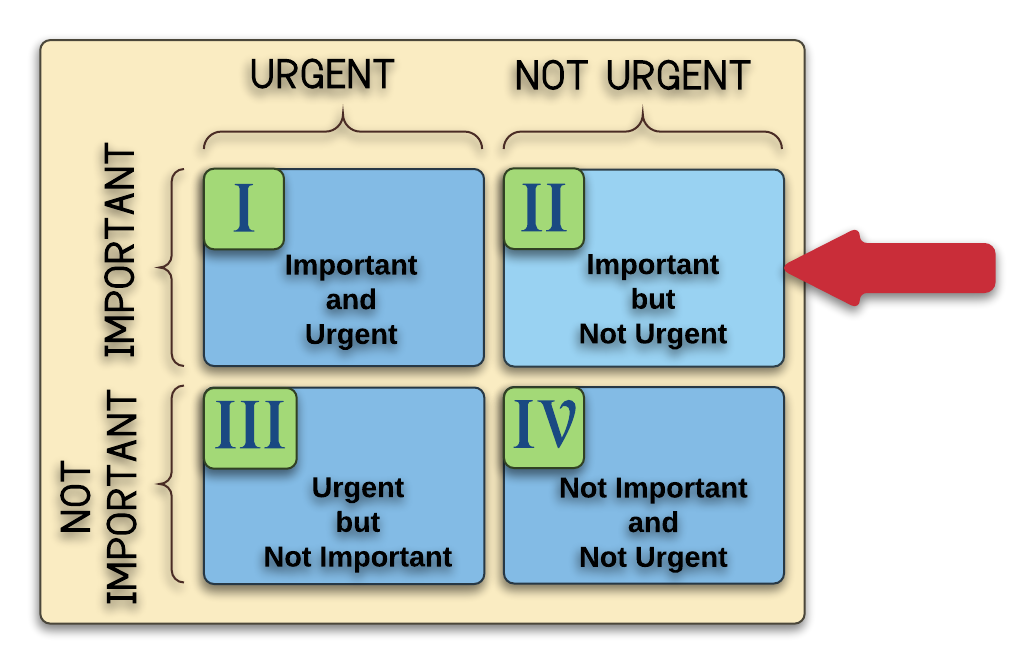
How does one setup a system that manages his or her time, ensuring the important things done in life in spite of a continuous flow of stressful weeks?
One effective strategy: Train thy self
Take special-forces training as an example. In the series “Surviving the Cut” special operations forces training includes:

- Ranger School
- Air Force Pararescue
- US Marine Recon
- Special Forces Divers
- Navy Explosive Ordnance Disposal (EOD)
- Marine Sniper


Another great training example series is “Navy SEALs: BUDS class 234.”
Even if you haven’t seen these series, most of us have an idea about the rigor of this type of training.
What’s interesting in many documentaries that I’ve seen (including books and post mission interviews), is the comments from special operations veterans about how they execute and survive in very stressful combat situations. Many veterans say, “I trusted my training”.
"I trust my training"
Isn’t that interesting.
In the heat of battle these amazing individuals with highly tuned senses and unwavering courage and amazing tenacity relay on TRAINING.
This is a huge lesson for us. So let’s get trained in our daily routine so we can handle office stress. Here’s is the training you need to keep it going.
#1 Setup the Routine and Tools
Routine is key. Almost every day of the year I’m reminded how important it is to have
routines or systems to keep on track. After listening to podcasts with very successful people, you quickly see they incorporate systems into their life in order to achieve their desired results.
One of my favorite podcast of all time is Tim Ferris’ interview with Scott Adams (Creator of Dilbert). In the podcast Scott Adams expresses how critical his daily systems are to his success.
In “The One Thing
 ” by Gary Keller he says, “The more creative a person is, the more they need a system.” You’d think it would be the opposite of that. But Keller argues that without a system you will just become distracted instead of productively creative.
Suggested routine for home
Wake up on time. It’s key to force this behavior. You’ve faced more pain in your life than getting up, so you can do it.Refuse to read e-mail or watch TV or even read the news. Getting distracted from your routine is easy, so make sure you keep the first part of your day clean from tempting distractions.
Work Out. (I alternate between Yoga and Running). This is important to your longevity, mental health, and ability to feel good and have energy.
Eat breakfast with your family. I’m big on pouring into my family’s life first thing in the day. It helps myself, my wife, and my kids enter the day with a mindset of thankfulness, thoughtfulness, kindness, and a spirit that is eager to learn.
Go to work.
Suggested routine for work
Look at your Calendar first. Your time is a map of your daily activities and you need to know the landscape. Don’t be distracted by e-mail inbox. Look to the calendar first.
Designate the biggest appointments you need to accomplish today as “all day” appointments. These are not meetings, they are deliverables that you need to make. (e.g. “Schedule training for the software team,” “Make sure that contract is signed by Pete,” or “Get the Bid to Joe for Atlas Project.”)
Put these on your calendar for each day of the week. Many of these come in e-mails. I’ve created a special button in Outlook to create meetings from e-mails so I can plop these items into the calendar quickly.
If you get projects and direction through e-mails put as many as possible into the calendar to keep yourself aware of the non-meeting deliverables.
Put non-urgent emails into an “!Action” folder at the top of e-mail box.
If the action comes in some other way besides e-mail, a phone call or post-it note, write yourself an e-mail for those actions and either put it into your “!Action” folder or into an “all-day” calendar event on the proper day.
Too many “all-day” events
Don’t get bogged down with too many daily assignments. Challenge yourself to reduce the number of daily events down to 3. Distribute the rest to different days or delete them altogether. Or perhaps put them in the “!Action” folder to deal with later.
If you are frantic at work, you won’t be able to become less frantic without FOCUS. FOCUS requires elimination. FOCUS is the result of shedding things so you can become immersed in one thing.
Review and update appointments daily.
#2 Refresh Your Mindset at Every Possible Interval
It’s so easy to get distracted during the day. Each time I come back to my computer from a meeting or discussion with my colleagues, I look at the calendar first, then at my e-mail inbox.
All Day Calendar First
Put the three big things at the top of the calendar. These are the “Big Rocks” in the parlance of Stephen Covey’s 3rd Habit: First things First. Stephen does a seminar exercise where he has a glass bowl half full of small pebbles and then another bucket with big rocks. The big rocks have labels on them like, “work out” or “time with family” or “write a book.” Stephen asks for a volunteer from the audience to come up to the stage and attempt to put all the big rocks into the bowl with the pebbles. People usually start stuffing the big rocks into the glass bowl only to find they won’t fit. There’s a lot of struggling to push rocks into the pebbles, digging around pebbles, and finally total frustration. The big rocks won’t all fit, unless…
Stephen Covey suggests the person pour out all the pebbles into the bucket, put in all the big rocks and pour all the pebbles on top.
Guess what. It all fits perfectly. That is why the big rocks must be done first.
Meetings on the Calendar Second
What is the next thing on my calendar and how can i prepare for it?
E-mail Third
Triage the incoming mass of information.
If I spend more than 5 minutes on triage and think I’m getting distracted, I go back to All-day events on my Calendar to make sure I can complete the Big Rocks.
Now you have something that looks like a routine. This is the training you can fall back on. We are lacking a little of the supporting philosophy, but that will come. Understanding the philosophy is often the next level of training.
Please leave a comment or send me e-mail and let me know what Big Rock you’re struggling to get done?
 . It’s a very densely packed book where every other sentence is a quote I should paste on my wall or share in a blog post.

